
OSHA 10 vs OSHA 30: Which One Do You Actually Need? (2026)
Picking the wrong OSHA card has cost workers real money and real time. A construction superintendent in Texas lost a $2.1 million public contract bid in 2025 because his crew held OSHA 10 cards instead of the OSHA 30 cards the city required. The difference between OSHA 10 vs OSHA 30 comes down to your job role — but most guides skip the part where that choice now has legal consequences in a growing number of states.
This article gives you a direct comparison of both courses: hours, cost, what each card qualifies you to do, and which fits your specific situation. This article is part of our complete guide to OSHA training.
If you’re a worker on the tools, you likely need OSHA 10. If you manage people on a job site, OSHA 30 is the card that protects your career.
What Is OSHA 10 vs OSHA 30?
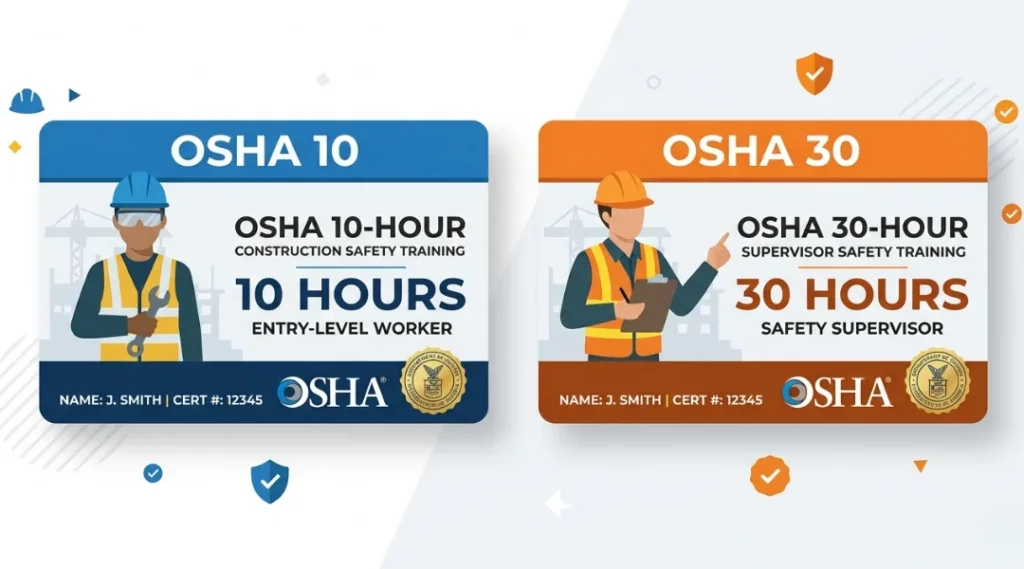
OSHA 10 is a 10-hour entry-level safety card for frontline workers, while OSHA 30 is a 30-hour supervisory course for managers and safety leads. OSHA 10 covers hazard recognition and avoidance basics. OSHA 30 goes deeper into compliance responsibilities, OSHA standards, and incident investigation. As of 2026, both cards are issued through OSHA-authorized trainers and remain valid indefinitely — no renewal required, though many employers set their own 5-year windows (OSHA.gov, 2025).
Why OSHA 10 vs OSHA 30 Matters in 2026
Choosing between these two courses incorrectly means repeating the process — and paying twice. Since January 2026, New York, California, and five other states expanded mandatory OSHA 30 requirements to all public construction projects over $500,000. Workers who held OSHA 10 on those sites faced 90-day compliance windows or removal from the project.
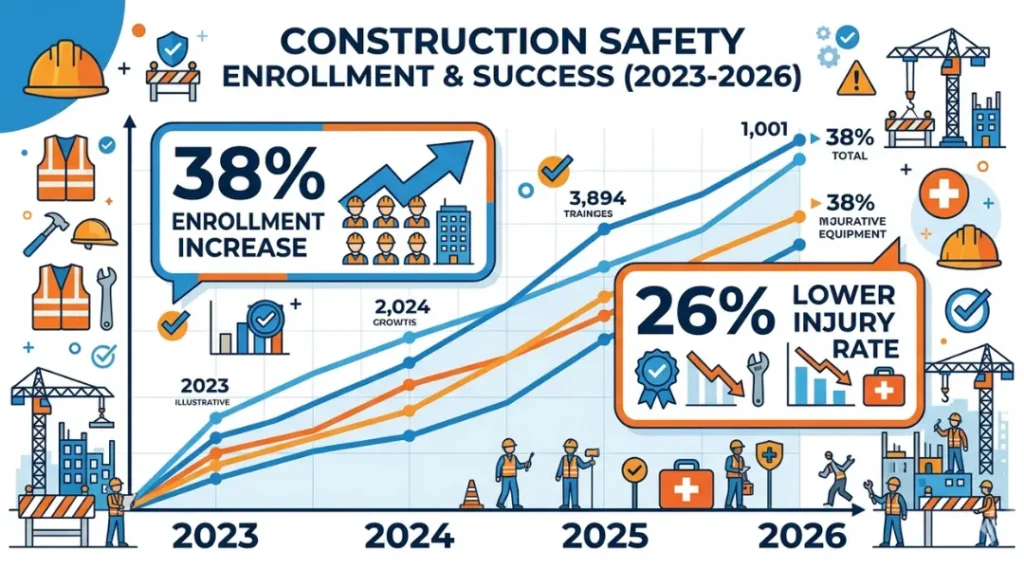
The Bureau of Labor Statistics reported 2.7 million nonfatal workplace injuries in 2024. Worksites where at least one supervisor holds an OSHA 30 card see a 26% lower injury rate compared to sites where only OSHA 10 training is present (OSHA Training Institute, 2025). That data now drives insurance pricing.
Insurers like Travelers and Zurich Financial offer premium reductions averaging 11% for contractors with certified OSHA 30 supervisors on staff. Workplace safety training enrollment jumped 38% between 2023 and 2025, with the sharpest increase from small contractors under 25 employees who previously skipped OSHA 30.
OSHA 10 still makes sense for most hourly workers. A site laborer who will never supervise others gains zero career benefit from the 30-hour course — until that role changes.
How OSHA 10 vs OSHA 30 Works: Step-by-Step
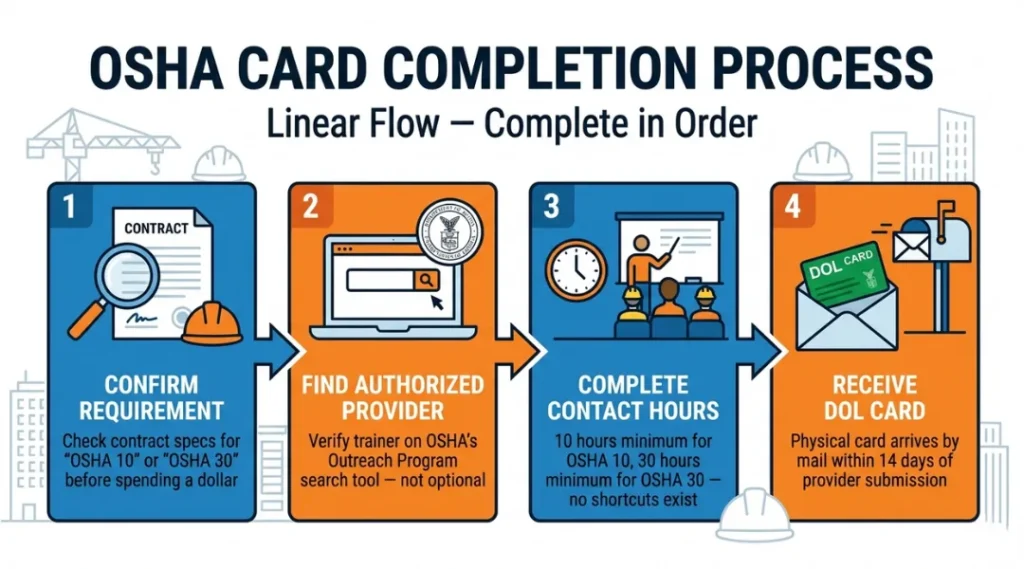
OSHA 10 completes in 10 contact hours across 2 days — online or classroom. OSHA 30 takes 30 contact hours spread across 3 to 4 days in the classroom or up to 6 weeks online. Both courses end with a DOL wallet card mailed within 2 weeks. Neither requires a proctored exam. The card arrives automatically upon verified completion through an OSHA-authorized provider.
Step 1: Confirm Which Card Your Job or Contract Actually Requires
Check your employment contract, collective bargaining agreement, or project specification sheet before enrolling in either course. Many workers skip this and pay for OSHA 10 only to discover the contract mandates OSHA 30.
Look for the phrase “OSHA 30-hour certification required” in Section 01 35 29 of construction spec sheets — that’s where safety requirements appear in most public project documents. If the phrase appears, OSHA 10 will not satisfy the requirement.
Common mistake here: assuming your employer knows which card you need. Ask the general contractor directly.
Step 2: Choose an OSHA-Authorized Training Provider
Only training from OSHA-authorized outreach trainers produces a valid DOL card. Providers like M2Y Safety, ClickSafety, and the National Safety Council all deliver authorized courses — but their support and completion timelines vary.
Check OSHA’s Outreach Training Program search at osha.gov before enrolling anywhere. A card from an unauthorized provider is worthless — OSHA cannot verify it, and general contractors will reject it on the spot.
Pro tip: Online OSHA 30 courses from M2Y Safety and ClickSafety allow you to pause and return. That matters for working adults who can’t block out three consecutive days.
Step 3: Complete the Required Contact Hours
OSHA 10 requires exactly 10 hours covering: introduction to OSHA, focus four hazards (falls, struck-by, caught-in/between, electrical), PPE, and health hazards. OSHA 30 covers all of that plus eight additional elective topics you select — including ergonomics, scaffolding, or confined space entry.
You cannot split these hours below OSHA’s minimum requirements. An “8-hour OSHA 10” is not a valid card. Any provider advertising fewer hours is selling a non-compliant course.
Step 4: Receive and Verify Your DOL Wallet Card
OSHA mails the physical card within 2 weeks of your provider submitting completion records. The card shows your name, course type, completion date, and the trainer’s OSHA authorization number.
Always verify the authorization number on OSHA’s website. Cards with invalid numbers are fraudulent — and using one on a federal project is a violation with real consequences.
Best Options for Completing OSHA 10 vs OSHA 30 Training
The three most reliable OSHA-authorized online providers in 2026 are M2Y Safety, ClickSafety, and the National Safety Council. Each has real differences that matter depending on whether you’re an individual worker or a company enrolling a crew. Pick based on your timeline and support needs — not price alone.
M2Y Safety is the fastest for individuals. Their OSHA 30 construction course completes in about 3.5 weeks at a pace of 90 minutes per day. The real limitation: customer support response averages 48 hours — which becomes a problem if your card is delayed and a job starts Monday.
ClickSafety costs $20 more for OSHA 30 at $189 vs. M2Y Safety’s $169. But it includes a direct phone support line. For time-sensitive job starts, that support line is worth the difference.
What most comparison guides skip: the provider name on your card matters to some employers. The National Safety Council carries weight with federal contractors that M2Y Safety doesn’t. The DOL card itself looks identical — but employer perception of where you trained can vary on federal projects.
| Tool / Product | Best For | Key Strength | Real Limitation | Price (2026) | Verdict |
|---|---|---|---|---|---|
| M2Y Safety | Individual workers needing fast online completion | Fastest OSHA 30 pacing — completable in 3.5 weeks | 48-hour average customer support response — poor for urgent issues | OSHA 10: $39 · OSHA 30: $169 | Best overall value for solo workers |
| ClickSafety | Workers with tight job-start deadlines needing live support | Phone support line for card delays and completion issues | Slightly slower course pacing than M2Y Safety | OSHA 10: $49 · OSHA 30: $189 | Best when your start date is non-negotiable |
| National Safety Council | Federal contractors and large GC job sites | Industry-recognized name — strongest employer acceptance nationally | Classroom scheduling requires booking weeks in advance | OSHA 10: $75 · OSHA 30: $249–$299 | Best for federal projects or union requirements |
| Procore Safety (via LMS) | Contractors enrolling crews of 10 or more workers | Bulk enrollment dashboard with real-time completion tracking | Requires active Procore subscription — not available to individuals | Group pricing from $89/seat for OSHA 30 | Best for companies managing crew-wide compliance |
Common OSHA 10 vs OSHA 30 Mistakes — And How to Fix Them
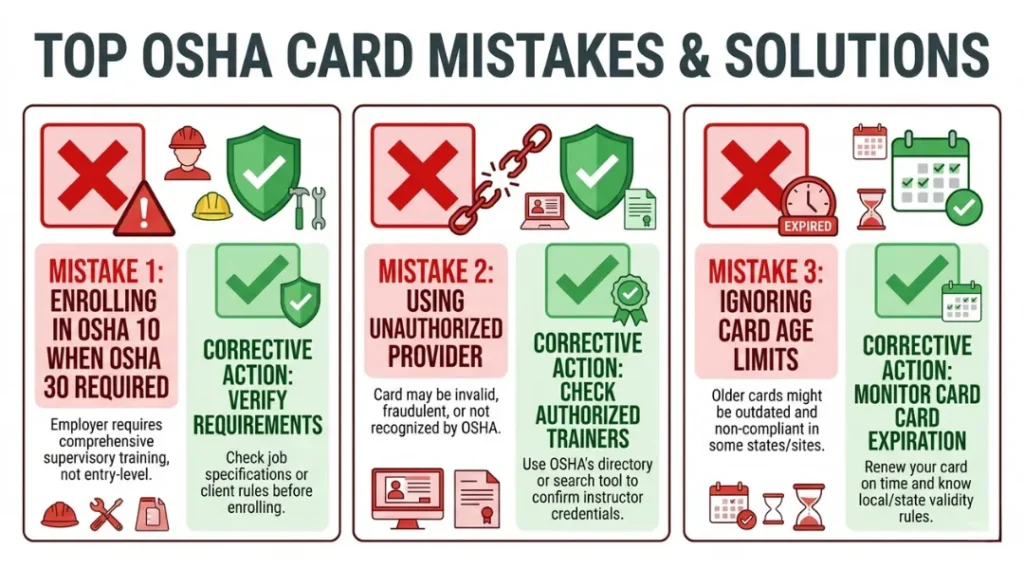
The most common mistake with OSHA 10 vs OSHA 30 is enrolling in OSHA 10 when the project spec sheet requires OSHA 30 — which forces a repeat enrollment costing $150–$299 and 30 additional hours. Most people make it because industry guides frame OSHA 10 as “the first step” and imply OSHA 30 comes later. That framing is wrong. Here’s how to check if you’re making it right now, and how to fix it in under 10 minutes.
Mistake 1: Treating OSHA 10 as a Prerequisite for OSHA 30
Most articles describe OSHA 10 as the starting point and OSHA 30 as the advanced course — implying you need one before the other. You don’t. OSHA 30 has no prerequisite. Anyone can enroll directly, regardless of prior training history.
Workers who complete OSHA 10 “to start” and then need OSHA 30 for a supervisor role have paid for both courses needlessly. If there’s any chance your role will involve supervisory responsibilities within two years, go directly to OSHA 30.
How to check right now: Ask your employer — “Does my current or expected role require OSHA 30?” If the answer is “probably” or “eventually,” enroll in OSHA 30 today.
Mistake 2: Buying from an Unauthorized Provider
Hundreds of online providers market “OSHA training” that produces no valid DOL card. Their certificates look professional. Their cards look real. None of them will pass a GC’s verification check on a job site.
The fix is simple: Go to osha.gov and search the Outreach Training Program database for the provider’s name before paying. If they’re not listed, close the tab.
How to check right now: Search your provider’s name at osha.gov/training/outreach. Takes 60 seconds. This single step has prevented fraudulent card situations that cost contractors thousands in compliance delays.
Mistake 3: Assuming the Card Never Expires
OSHA 10 and OSHA 30 cards technically have no expiration date. But many employers and general contractors set their own validity windows — typically 5 years. New York City’s Department of Buildings requires renewal every 5 years for all site safety personnel. A 2018 card may be legally valid but practically unacceptable.
A crew of 14 electricians arrived on a healthcare construction project in New Jersey in 2025 holding OSHA 10 cards dated 2016. The project required cards from 2020 or later. Six workers were sent home on Day 1 — the contractor absorbed $9,400 in delay costs that week.
How to check right now: Email the project safety coordinator and ask: “Does the site safety plan have a recency requirement for OSHA cards?”
Quick Win: Check your existing card’s date before applying to any job requiring OSHA certification. If it’s more than 5 years old, re-enroll. An online OSHA 10 costs $39 and 10 hours — far cheaper than the job-site delay it prevents.
OSHA 10 vs OSHA 30: Frequently Asked Questions
OSHA 30 has no prerequisite. Any worker, regardless of prior safety training history, can enroll directly in the 30-hour course. Taking OSHA 10 first wastes time and money if your job or contract already requires the 30-hour card. Enroll in the course your current role demands — then upgrade only if your responsibilities change.
Your authorized training provider submits completion records within 10 business days of course completion. The DOL wallet card arrives by mail within 14 business days after that — plan for 3 to 4 weeks total from course completion to card in hand. If your job starts sooner, ask your provider for a completion certificate as interim proof of training.
Online OSHA 10 and OSHA 30 cards are identical to classroom cards — the DOL wallet card shows no delivery method. However, some union contracts and federal project specifications require classroom-only completion. Confirm the format requirement with your employer or GC before paying for any online course to avoid a surprise rejection on Day 1.
Contact your original training provider directly — not OSHA. Providers retain completion records and issue replacement cards. If the original provider is no longer operating, contact the OSHA Outreach Program at your regional OSHA office. Keep a digital photo of your card immediately upon receiving it. Replacement processing takes 2 to 4 weeks.
OSHA 30 is not a safety officer certification. It is a hazard recognition and compliance training credential. Becoming a Certified Safety Professional (CSP) or Associate Safety Professional (ASP) requires separate examination through the Board of Certified Safety Professionals (BCSP). OSHA 30 counts toward experience hours for the ASP application but does not replace the certification exam.
Related Topics Worth Exploring
Understanding which card you need is step one. Knowing what it costs is step two — our OSHA certification cost guide breaks down current pricing for both cards, online vs. classroom, and fee differences for India and UAE.
If your OSHA 30 is a step toward a safety leadership role, read our guide to becoming a safety officer — it covers the qualifications, certifications, and salary trajectory that go beyond the OSHA card itself.
For the complete OSHA training guide, start here: Complete OSHA Training Guide.
Conclusion
An OSHA 10 card qualifies you to work safely. An OSHA 30 card qualifies you to lead safely — and in 2026, that difference is written into more contracts, state laws, and insurance policies than at any point before. The cost gap between OSHA 10 vs OSHA 30 online is about $130. The career gap between them can be measured in job eligibility on projects worth millions.
In the next 10 minutes: open the comparison table above, find the provider that matches your timeline and budget, and check your project spec sheet for which card is required before enrolling. The 30-hour course completes in about 3.5 weeks online — 3.5 weeks from now, your position on any job site is more secure. For the complete OSHA training guide, start here: Complete OSHA Training Guide.
Pingback: How Much Does OSHA Certification Cost in 2026?