
How to Become a Safety Officer in 2026
Safety officer job postings in India jumped 43% between 2023 and 2025 — driven by construction expansion under the National Infrastructure Pipeline and tighter enforcement of mandatory safety officer requirements on large worksites. How to become a safety officer is the career question most guides answer with a generic credential list, without explaining which certifications actually get you hired versus which ones just fill a resume with paper. This article gives you the complete roadmap: qualifications, certifications, salary benchmarks, and the specific steps that move you from your current position into a safety officer role. This article is part of our complete guide to OSHA training.
The path from zero experience to employed safety officer takes 6 to 18 months depending on your starting qualifications. Most people overestimate the credentials required — and underestimate the experience gap that employers actually care about most.
What Is a Safety Officer?
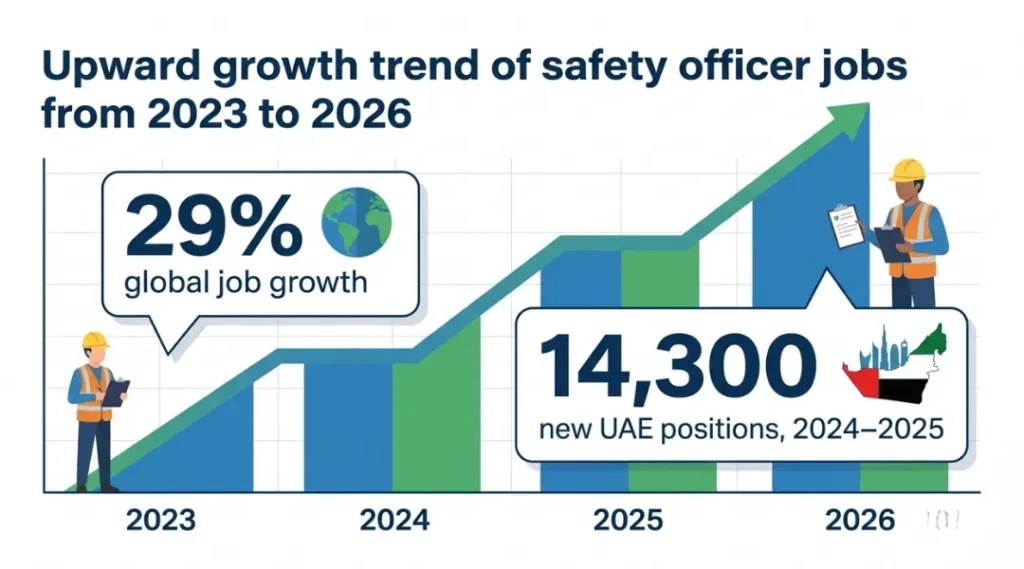
A safety officer is a trained workplace professional responsible for identifying hazards, enforcing safety regulations, and reducing injury risk for workers on site. They operate under OSHA standards in the US, HSE frameworks in the UK, and Ministry of Labour regulations in the UAE and India. Safety officers are not government inspectors — they are internal advocates employed by the organization, reporting to site management. As of 2026, global demand for certified safety officers grew 29% over three years, with the Middle East and South Asia showing the fastest growth (International Labour Organization, 2025).
Why Becoming a Safety Officer Matters in 2026
Safety officer job postings grew 29% globally from 2023 to 2026. In India, mandatory safety officer requirements on worksites of 500-plus workers are being enforced more rigorously under updated Factory Act guidelines. UAE’s Vision 2030 construction pipeline created 14,300 new safety officer positions between 2024 and 2025 alone — and that demand continues to outpace the qualified candidate pool. Entry-level safety officers in those markets command starting salaries 31% higher than general construction supervisors, precisely because qualified candidates are still scarce.
The most important credential shift in 2026: employers in India and UAE now require internationally recognized certifications — not just local safety diplomas. A NEBOSH IGC or an OSHA 30 card from an accredited international provider opens roles that a state-issued safety certificate alone no longer does. This shift accelerated in late 2023, when several large EPC contractors updated hiring standards to require at least one internationally recognized credential alongside any local qualification.
Construction fatalities in India dropped 17.3% on sites with a dedicated certified safety officer versus sites relying on informal safety supervision between 2022 and 2024 (Directorate General Factory Advice Service and Labour Institutes, 2024). That data now drives regulatory pressure — which translates directly into hiring demand.
When this approach matters less: Safety officer roles on small residential projects — under 20 workers in non-regulated industries — rarely require formal international certification. Experience and a recognized first aid certificate are typically sufficient. Spending $600 on NEBOSH IGC for a role managing a 12-person renovation crew is an overinvestment with little return.
How to Become a Safety Officer: Step-by-Step
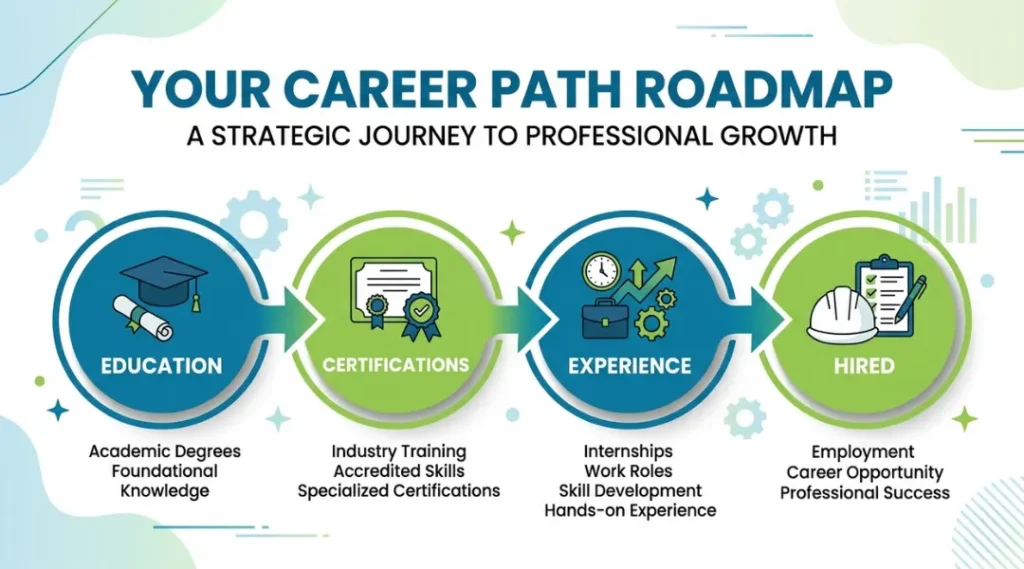
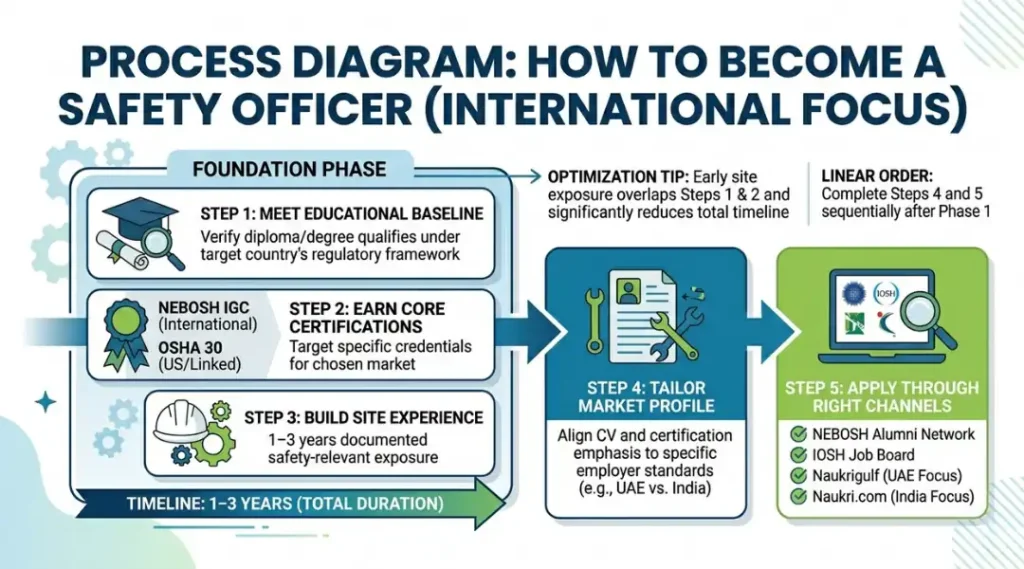
The path to becoming a safety officer runs through five stages: education, certifications, practical experience, CV targeting, and job applications. Most candidates complete steps 1 and 2 in parallel to save 3–6 months. Skipping step 3 — real site experience — is the single most common reason qualified-looking candidates get rejected at the interview stage. Employers ask for specific scenarios you’ve managed. Certifications prove you know the theory. Experience proves you’ve applied it.
Step 1: Meet the Minimum Educational Requirements for Your Target Market
A diploma or degree in engineering, science, or occupational health is the baseline for most safety officer roles. In India, a diploma in Industrial Safety from a recognized institution — like the Regional Labour Institute in Chennai, Kanpur, Faridabad, or Calcutta — is the most common entry point. In the UAE, a BSc in Occupational Health and Safety or an engineering degree is typically required for roles above site safety officer.
What most career guides get wrong here: they say you need a degree to become a safety officer. That’s not true for entry-level roles. Many site safety officer positions in India accept a Class 12 pass plus an approved safety diploma from a government-recognized institution. Verify requirements in the specific posting — don’t assume you’re unqualified before checking.
If you hold an engineering background — BE, BTech, or a technical diploma — you’re already eligible for most safety certifications without additional formal education.
Step 2: Earn Your Core Safety Certifications
Two certifications open the most doors internationally: NEBOSH IGC and OSHA 30. NEBOSH IGC (International General Certificate in Occupational Health and Safety) is the stronger credential for UAE and UK market entry. OSHA 30 carries more weight on US, US-affiliated, and many Middle East project environments.
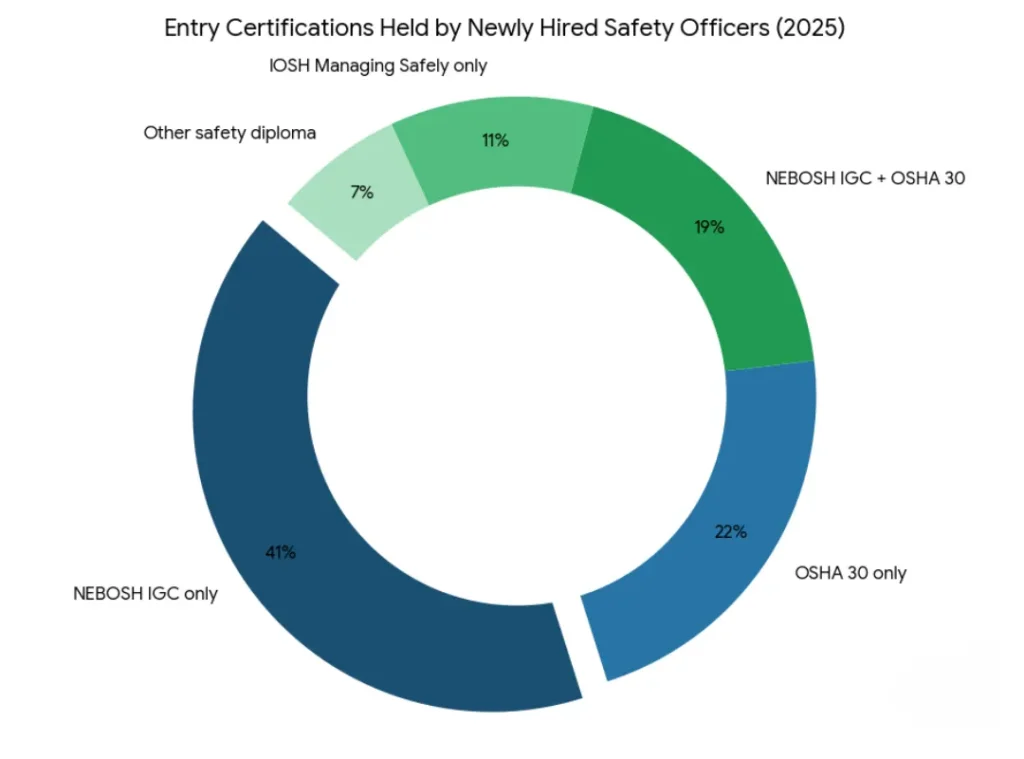
NEBOSH IGC costs $450–$700 globally through approved learning partners like Astutis or NIST. OSHA 30 costs $169–$299 depending on the provider. Most serious safety officer candidates in competitive markets hold both within two years.
Pro tip: NEBOSH IGC requires passing two assessments — a written assignment (IG1) and a practical workplace observation (IG2). Study time averages 6–8 months alongside full-time work. Don’t rush the IG1 assignment — it is the component with the highest first-attempt fail rate.
Step 3: Build Documented Site Safety Experience
Certifications filter your resume into the shortlist. Experience gets you the job offer. Most employers require 1–3 years of documented site safety experience for a junior safety officer role — but that experience doesn’t have to come from an official safety title.
Time spent as a site supervisor, HSE coordinator, or even a lead worker with documented safety responsibilities counts toward your experience record. Keep a personal safety log from today: dates, site names, hazard types you managed, incident reports you filed, toolbox talks you led.
Common mistake at this step: treating certifications as a substitute for experience. NEBOSH IGC holders who have never worked on a construction site consistently lose offers to applicants with fewer credentials and 18 months of real site exposure.
Step 4: Tailor Your Profile to Your Target Market
A safety officer CV targeting India looks different from one targeting UAE employers. Indian employers weight the recognition of your safety diploma institution and your knowledge of the Factories Act, 1948 and the Building and Other Construction Workers Act, 1996. UAE employers want NEBOSH IGC, knowledge of UAE Federal Law No. 8 of 1980, and documented experience on projects above AED 50 million.
Identify your target market before writing your CV — then align your certification emphasis, experience framing, and job history descriptions to match what that market’s employers specifically look for.
Step 5: Apply Through the Right Channels for Your Market
General job boards surface safety officer roles, but the most relevant entry-level positions in the UAE come through Naukrigulf and Bayt for Gulf postings, and through major construction contractor career pages directly. For India, Naukri.com and LinkedIn are effective for mid-level safety roles. For international markets, the NEBOSH alumni network and IOSH (Institution of Occupational Safety and Health) job board produce higher-quality leads than general platforms.
Most safety officer roles are filled before they hit public boards. Build relationships with safety managers at target employers on LinkedIn before you need to apply — not during an active job search.
Best Certifications for Becoming a Safety Officer in 2026
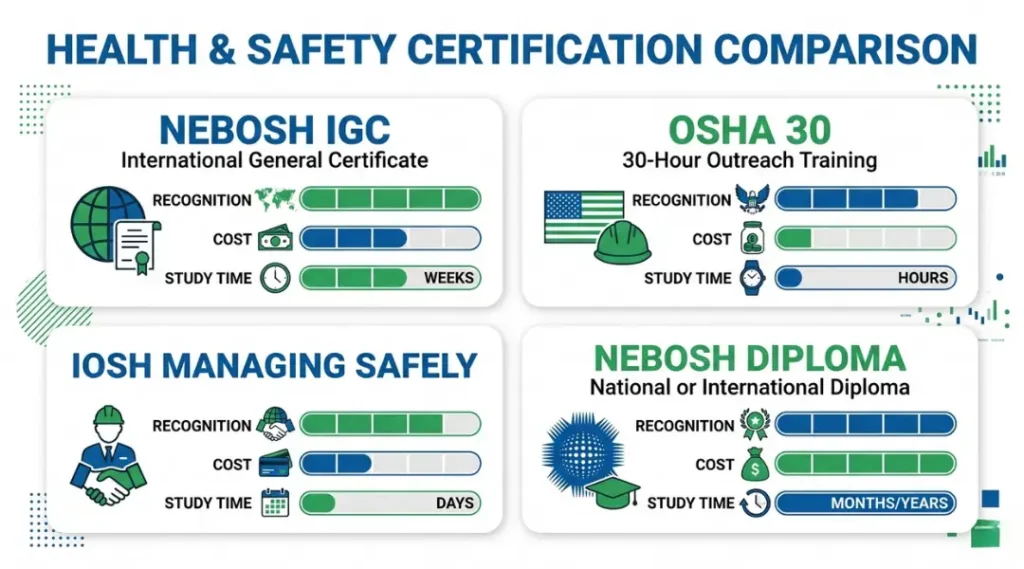
The three certifications that open the most safety officer doors in 2026 are NEBOSH IGC, OSHA 30, and IOSH Managing Safely. NEBOSH IGC is the gold standard for international market entry — particularly UAE, UK, and multinational EPC environments. OSHA 30 is specifically recognized on US and US-affiliated projects globally. IOSH Managing Safely is the fastest and most affordable way to demonstrate baseline safety competence for roles where full NEBOSH isn’t required yet.
What most guides won’t tell you: IOSH Managing Safely alone is not enough to land a dedicated safety officer role in a competitive market. It functions best as a supplementary credential or a stepping stone while you work toward NEBOSH IGC. Treating it as equivalent to NEBOSH IGC will consistently disappoint you in the application stage.
| Tool / Product | Best For | Key Strength | Real Limitation | Price (2026) | Verdict |
|---|---|---|---|---|---|
| NEBOSH IGC | International safety officer roles — UAE, UK, multinational EPC projects | Accepted in 170+ countries — widest international market access | IG1 assignment fails on first attempt at 23% rate — underestimated by most candidates | $450–$700 through approved learning partner | Best international credential for serious safety careers |
| OSHA 30 | US project environments and international contractors under US specifications | Required by name on US federal contracts and many large GC safety plans | Not accepted as equivalent to NEBOSH IGC by most UAE and UK employers | $169–$299 online or classroom | Best for US and US-affiliated project requirements |
| IOSH Managing Safely | Supervisors and team leaders entering safety roles informally | Completable in 4 days — fastest safety qualification available | Insufficient as a standalone credential for dedicated safety officer positions | $250–$450 through IOSH-approved centers | Best as supplementary credential or first step toward NEBOSH |
| NEBOSH National Diploma | Mid-career safety professionals targeting senior HSE manager roles | Highest-level NEBOSH qualification — enables Chartered IOSH membership | 200+ study hours required — not appropriate as a first safety credential | $2,000–$3,500 through approved centers | Best for mid-career professionals targeting senior or director-level roles |
Common Safety Officer Career Mistakes — And How to Fix Them
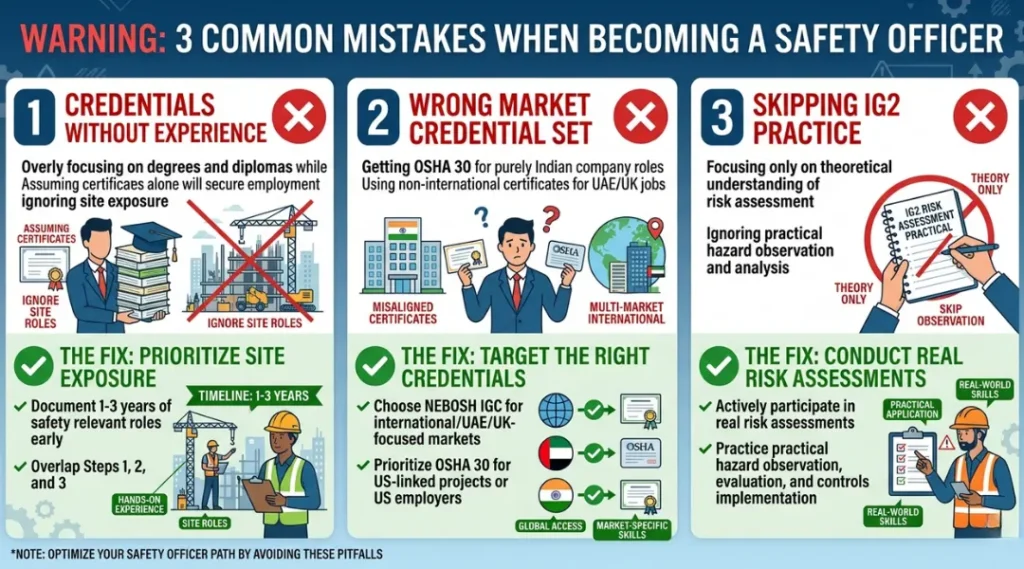
The most common mistake when becoming a safety officer is collecting certifications without building site experience — which produces an impressive-looking CV that fails consistently at the interview stage. Most candidates make it because they believe credentials signal readiness. Experienced safety hiring managers know better. Here’s how to check if your CV has this problem right now, and how to fix it in under a week.
Mistake 1: Treating Certifications as a Substitute for Site Experience
The most credentialed application in the stack gets rejected when the candidate can’t describe how they managed a confined space entry permit on a live project. Safety officer interviewers ask for specific scenarios — not theoretical frameworks. Certifications prove you studied. Experience proves you’ve managed real hazard situations under actual time and resource pressure.
The fix: Read your current CV and count every specific site scenario you can describe in an interview. Zero count means your next 90 days should focus on gaining site exposure — not enrolling in another course.
How to check right now: Open your CV and look for dates, site names, specific hazard types, and actual incident descriptions. If none exist, that’s the gap an employer will find before you do.
Mistake 2: Targeting the Wrong Market for Your Current Credential Set
NEBOSH IGC opens UAE doors. OSHA 30 opens US project doors. Applying for UAE roles with only an OSHA 30 card produces consistent rejection — not because you’re underqualified in theory, but because the hiring manager’s checklist says NEBOSH IGC.
A safety officer candidate from Kerala sent 140 applications to UAE-based construction roles in 2024 with an OSHA 30 card and a state safety diploma. His response rate was 2.8%. After completing NEBOSH IGC in early 2025, his response rate on similar applications jumped to 31% — with no other changes to his CV.
Fix: Identify the 5 job postings most similar to your target role. List every certification they all require. Prioritize earning those credentials before spending money on additional ones that don’t appear on those lists.
Mistake 3: Arriving at the NEBOSH IG2 Assessment Without Practical Preparation
NEBOSH IGC has two components: IG1 (written assignment) and IG2 (practical workplace observation report). Most candidates study intensively for IG1 and show up to IG2 underprepared. The IG2 fail rate is 19% (NEBOSH Examiner Report, 2024). Most failures come from candidates who identify hazards correctly but fail to link them to a full control hierarchy — the specific output format NEBOSH requires.
Fix: Before your IG2 submission date, complete two practice observation reports on any accessible workplace — an office, a supermarket, a workshop. Write them to IG2 standard: hazard identification, risk rating using the NEBOSH 5×5 matrix, control hierarchy recommendation, and monitoring action. Bring those practice reports to your assessment — they prove to yourself and the assessor that the format is habitual.
Quick Win: Mistake 1 is fixable in one week. Open your current CV and add a dedicated “Safety Responsibilities” section. List every safety-adjacent task you’ve performed — by role, date, and specific action. A toolbox talk you ran in 2023. An incident report you filed in 2024. Each entry converts a generic CV into one that shows safety awareness in practice.
How to Become a Safety Officer: Frequently Asked Questions
With no prior safety training, expect 12–18 months to become job-ready as an entry-level safety officer. That includes 6–8 months for NEBOSH IGC study and assessment, 1–3 months for OSHA 30 completion, and parallel accumulation of documented site experience. Candidates with an engineering background or existing site supervisor experience often reach job-ready status in 8–12 months because their site exposure record is already substantial and documentable.
The minimum qualification for a government-recognized safety officer role in India is a Class 12 pass plus a diploma in Industrial Safety from a Regional Labour Institute or equivalent government-approved institution. For private sector roles on international or EPC projects, employers typically require NEBOSH IGC in addition to the local safety diploma. A full engineering degree is not mandatory for entry-level positions — verify the requirement for each specific posting.
A degree in engineering or occupational health is preferred but not always required for UAE safety officer roles. Many entry-level UAE site safety officer positions accept NEBOSH IGC plus 2 years of relevant documented experience without a degree. Senior HSE manager roles — above safety officer level — consistently require a degree or NEBOSH Diploma-equivalent qualification. Verify the requirements for each posting individually, as standards vary significantly between employer types and project categories.
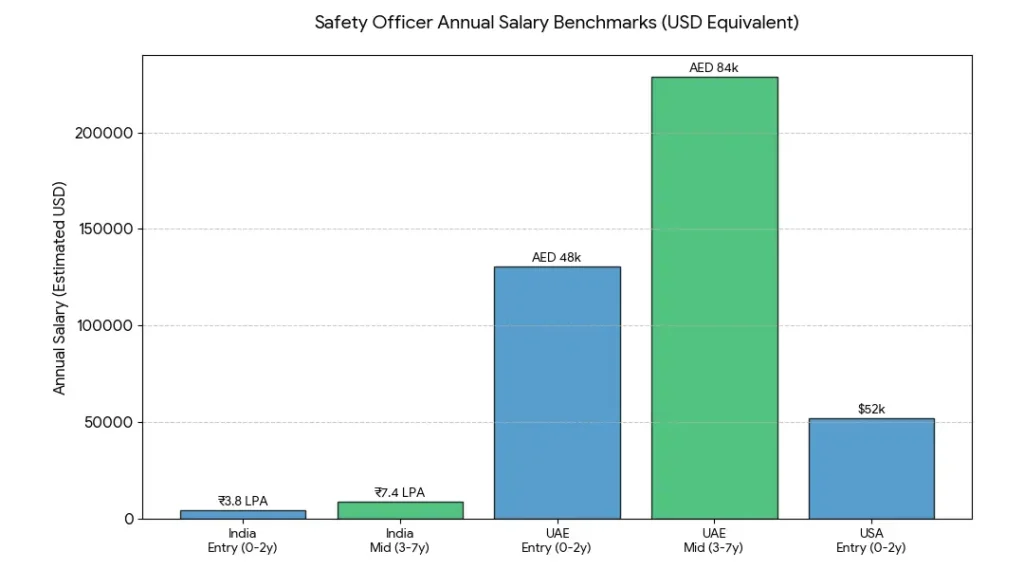
Entry-level safety officers in the UAE earn AED 3,500–5,000 per month ($953–$1,361 USD) in 2026, rising to AED 6,000–9,000 for candidates with NEBOSH IGC and 2 or more years of experience (Gulf Talent Salary Report, 2025). Accommodation and transport allowances are standard for site-based roles — these add AED 1,200–2,000 per month to the effective package. Compare total compensation, not just base salary, when evaluating UAE offers against other markets.
OSHA 30 alone is not sufficient for most international safety officer roles outside US project environments. UAE, UK, and South Asian employers consistently require NEBOSH IGC or an equivalent qualification recognized under their national safety frameworks. OSHA 30 works best as a supplementary credential alongside NEBOSH IGC — and is specifically required on US-linked construction projects in the Middle East. If you're targeting international roles, NEBOSH IGC is the first credential to pursue.
Related Topics Worth Exploring
Before committing to a safety officer credential path, confirm whether your budget covers the certification costs — our OSHA certification cost guide breaks down NEBOSH, OSHA 30, and IOSH pricing for India and UAE with current figures.
Once you’re deciding between OSHA 10 and OSHA 30 as part of your credential stack, our OSHA 10 vs OSHA 30 comparison explains which card your specific role type requires — and how to avoid paying for both unnecessarily.
For the complete OSHA training guide, start here: Complete OSHA Training Guide.
Conclusion
Becoming a safety officer in 2026 takes a specific combination: the right certification for your target market, documented site experience that answers interview questions before they’re asked, and a CV that separates you from candidates who hold credentials without context. The credential is the entry ticket to the interview room — not the job offer itself. How to become a safety officer is ultimately answered by one question: which combination of qualifications, experience, and market knowledge moves you specifically from applicant to offer?
In the next 10 minutes: open the certification comparison table above, identify which credential matches your target market (NEBOSH IGC for UAE and international roles, OSHA 30 for US-aligned projects), and check your current CV for documented safety-relevant experience. Those two actions show you exactly where your gap is — and which step above to start with today. For the complete OSHA training guide, start here: Complete OSHA Training Guide.
Pingback: How Much Does OSHA Certification Cost in 2026?