
OSHA 10 Hour Training
⚡ Key Takeaways |
OSHA 10-Hour is the entry-level safety training for construction and general industry workers. It covers hazard recognition, worker rights, and OSHA standards in 10 contact hours. It is voluntary nationally but state-mandated in Connecticut, Missouri, Nevada, New York, and Rhode Island for certain projects. Online completion through an OSHA-authorized provider is 100% legitimate. The DOL card arrives within 90 days of course completion. |
Table of Contents
Toggle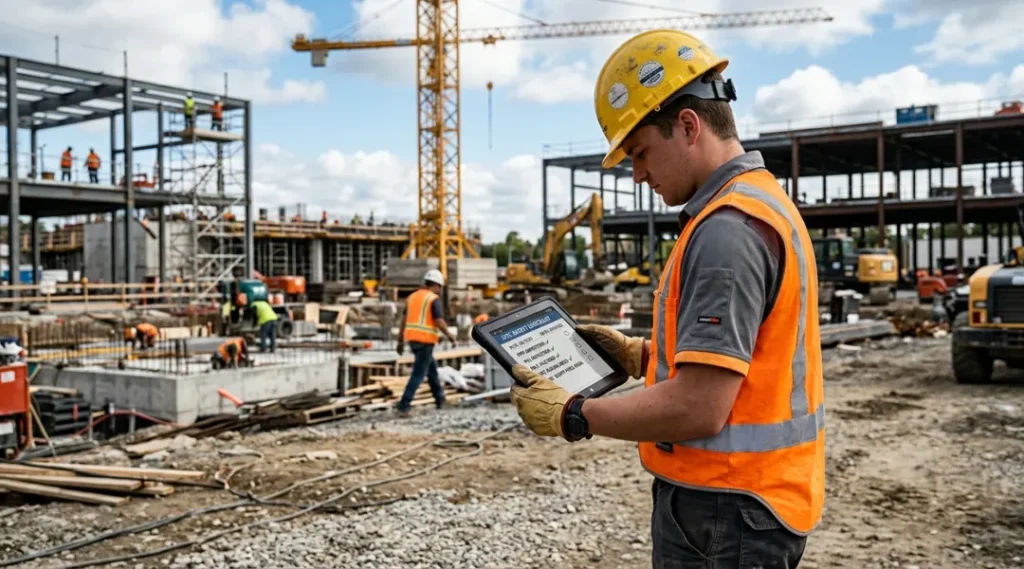
More than 2 million workers complete OSHA 10-hour training every year, and the number keeps climbing. Why? Because employers increasingly require it for site access, state governments mandate it on public projects, and workers know that safety credentials separate job candidates in a tight market. But here’s what most guides don’t tell you: OSHA 10-hour training is not a license, not a universal certification, and not the same as OSHA 30. Knowing exactly what it is, and what it isn’t, will help you choose the right training, enroll with the right provider, and use your completion card the right way. This guide covers everything: course types, state mandates, step-by-step enrollment, honest cost breakdowns, and a clear look at how OSHA 10 fits into a safety career.
OSHA 10-hour training is an entry-level workplace safety course delivered through OSHA’s Outreach Training Program. It works by teaching workers to recognize hazards, understand their rights, and follow OSHA safety standards over a minimum of 10 contact hours. Unlike employer-specific safety inductions, it results in an official DOL course completion card recognized by employers across multiple industries and countries. As of 2026, OSHA reports more than 1.7 million OSHA 10-hour cards issued annually through authorized providers (OSHA, 2024).
What Is the OSHA 10-Hour Training Course?
OSHA 10-hour training is the introductory level of OSHA’s Outreach Training Program, designed for entry-level workers across construction and general industry. It covers hazard recognition, worker rights, employer responsibilities, and complaint procedures. Completion earns a DOL wallet card: not a license, but a recognized proof of foundational safety education.
Let’s start with what the card actually means. The OSHA Outreach Training Program was created to train workers in the basics of occupational safety. OSHA describes the 10-hour class as being ‘intended to provide workers with awareness of common job-related hazards.’ That phrasing is deliberate. Awareness: not mastery, not authorization to operate equipment, and not a substitute for task-specific training.
Think of OSHA 10 like a driver’s education class. It teaches you the rules of the road. It doesn’t mean you’re qualified to drive a Formula 1 car.
The course covers a mix of mandatory and optional topics. OSHA requires specific content: Introduction to OSHA, Managing Safety and Health, and subjects tied to the top hazards in that industry. Trainers then select elective topics from an approved list based on their student audience. That’s why two workers can both hold OSHA 10 cards and have covered different specific hazard modules, depending on their provider and course track.
Who issues the card?
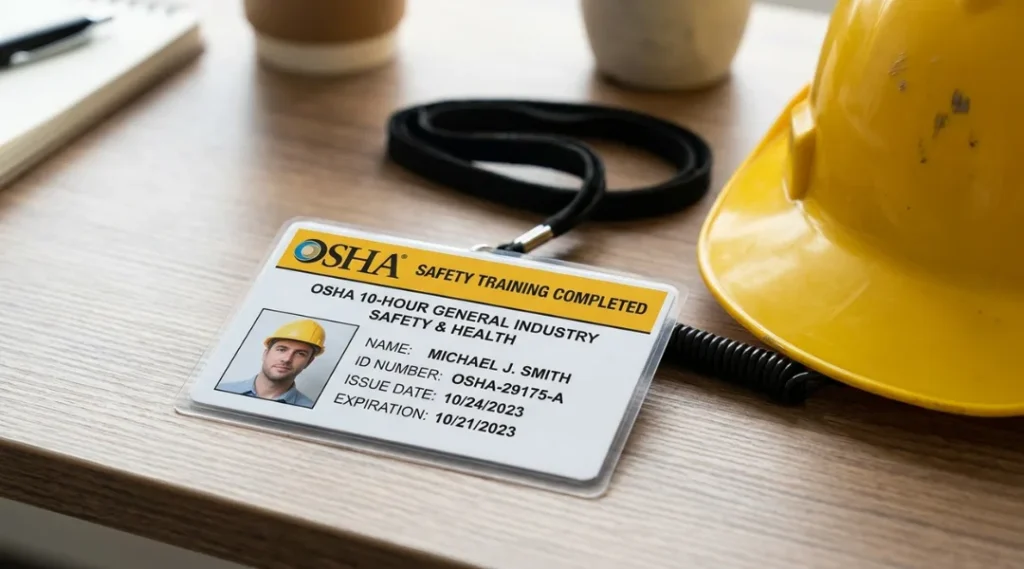
OSHA itself does not deliver the training directly. It authorizes trainers and online providers who meet OSHA’s curriculum and quality standards. These trainers then issue the course completion card, a laminated pocket card with the worker’s name, provider, course type, and completion date. OSHA does not maintain a national searchable database of cardholders.
Why OSHA 10-Hour Training Matters in 2026
OSHA 10 matters more in 2026 than it did five years ago because state mandates have expanded, major contractors now require it as a minimum site access standard, and international employers in construction and oil and gas increasingly ask for it alongside local safety certifications. The compliance environment has shifted from ‘encouraged’ to ‘expected’ in many sectors.

The numbers back this up. OSHA’s Outreach Training Program issued over 6.51 million cards between FY 2021 and FY 2025, with the construction sector consistently representing the largest share of completions (OSHA Outreach Training Program, 2024). That volume reflects genuine employer demand, not government mandates alone.
Here’s what changed recently. In 2023, New York’s Construction Industry Fair Play Act enforcement expanded to tie OSHA 10 compliance to subcontractor eligibility on many publicly funded projects. Nevada updated its OSHA 10 mandate for residential and commercial construction projects over a specific value threshold. Both moves followed earlier actions in Connecticut, Missouri, and Rhode Island, where similar laws already existed.
The international dimension is also worth understanding. Workers from India, UAE, Saudi Arabia, and Malaysia who want to compete for positions on international construction projects, offshore platforms, and infrastructure contracts are now regularly asked for OSHA 10 or OSHA 30 alongside NEBOSH or IOSH credentials. What was once an ‘American safety credential’ is now a globally recognized signal of hazard awareness.
One thing I’ve seen consistently in the safety training market: the employers who ask for OSHA 10 as a minimum are not doing it just for compliance paperwork. They are filtering for workers who understand how to spot a hazard before it becomes an incident. That is genuinely useful on a live job site.
The Bureau of Labor Statistics reported the fatal work injury rate in the US construction sector at 9.8 per 100,000 full-time equivalent workers in 2022 (BLS Census of Fatal Occupational Injuries, 2023). Training doesn’t eliminate that risk, but contractors with stronger safety cultures, including baseline training requirements, consistently show lower incident rates.
OSHA 10 Construction vs. General Industry: Which Do You Need?
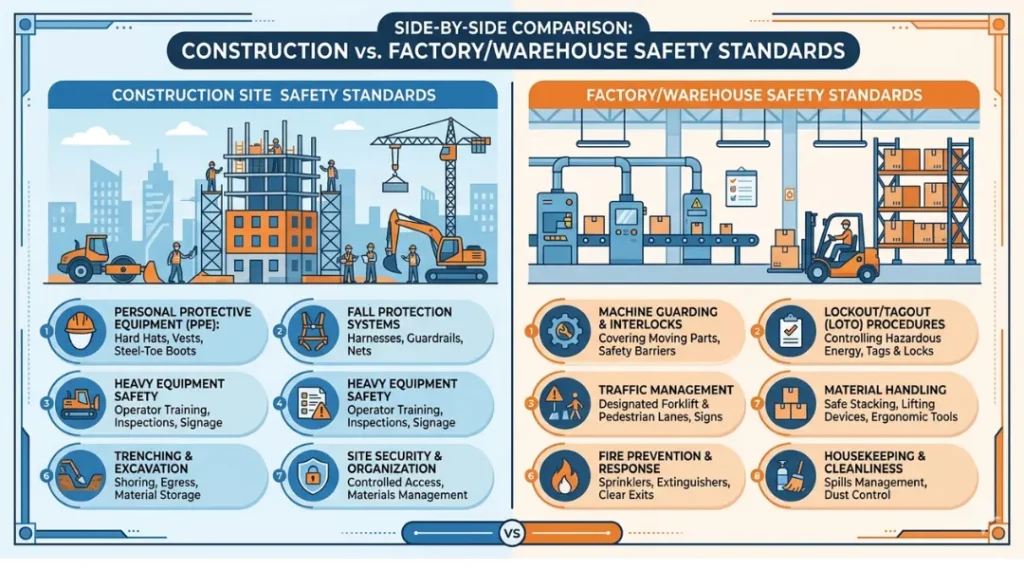
OSHA 10 Construction and OSHA 10 General Industry are separate courses with different hazard focus areas. Construction covers falls, scaffolding, excavation, electrical, struck-by, and caught-in hazards specific to jobsites. General Industry covers machine guarding, hazard communication, lockout/tagout, and workplace ergonomics. Choosing the wrong track will not satisfy employer requirements in the other sector.
This is the most common source of confusion for first-time students. Both courses run 10 hours. Both result in the same style of DOL card. But they cover very different hazards because the workplaces they address are very different environments.
Comparison Factor | OSHA 10 Construction | OSHA 10 General Industry |
Primary Audience | Site workers, laborers, tradespeople | Factory, warehouse, healthcare, logistics |
OSHA Standards Covered | 29 CFR Part 1926 | 29 CFR Part 1910 |
Key Hazard Modules | Falls, scaffolding, excavation, cranes, electrical | Lockout/tagout, machine guarding, HazCom, PPE |
Mandatory Topics | Intro to OSHA, Managing Safety, 4 Focus Four hazards | Intro to OSHA, Managing Safety, 2+ hazard modules |
Typical Student Profile | Contractors, subcontractors, apprentices | Manufacturing technicians, warehouse associates |
State Mandates Apply? | Yes: NY, CT, NV, MO, RI for certain projects | Less common but sector-specific rules exist |
International Recognition | Strong in construction and infrastructure projects | Strong in manufacturing and oil and gas sectors |
Typical Course Cost | USD $79-$99 / AED 290-365 / INR 6,600-8,300 online | USD $79-$99 / AED 290-365 / INR 6,600-8,300 online |
What if your job sits in between? For example, if you work in a facility maintenance role that includes both plant operations and occasional construction-style tasks, choose the track that matches your primary workplace environment. When in doubt, ask your employer which standard they enforce on your site.
In my experience advising workers transitioning into safety roles, choosing the construction track when your job is actually general industry is the second most common enrollment mistake (after choosing the wrong provider). Fix it early. It’s much easier to take the right course from the start than to explain the discrepancy on a job application later.
How to Complete OSHA 10-Hour Training Step by Step
Completing OSHA 10-hour training requires five steps: choose your industry track, select an OSHA-authorized online or in-person provider, complete all required contact hours, pass any required assessments, and wait for your DOL completion card, which arrives within 90 days. The entire process can be done 100% online through an authorized provider.
Step 1: Confirm which industry track you need
Decide between Construction and General Industry based on your workplace. If your employer has already told you which track they require, follow their guidance exactly. If you’re choosing independently, match the OSHA standard that governs your workplace: Part 1926 for construction, Part 1910 for general industry.
Pro tip: if you’re internationally based and plan to work on construction projects in the Gulf region, the Middle East, or Southeast Asia, the Construction track is almost always the one that resonates with project managers on those sites.
Step 2: Choose an OSHA-authorized provider
Only authorized trainers and online providers can issue valid OSHA completion cards. OSHA maintains and publishes its list of authorized online providers. Currently authorized online platforms include Self-Paced Online Platforms, Accredited Online Safety Schools, Entry-Level Safety Academies, Corporate and Group Training Providers, and other accredited online platforms, among others.
For in-person training, an OSHA-authorized trainer must deliver the course. You can find local trainers through OSHA’s Training Institute Education Centers, which operate at accredited academic institutions across the United States.
Step 3: Enroll and complete all required hours
OSHA requires a minimum of 10 contact hours for the 10-hour course. Online providers typically structure this across modules covering mandatory topics (Intro to OSHA, Managing Safety & Health, the major hazard categories) and elective topics selected by the provider.
You must complete all required time. OSHA does not allow shortcuts or hour skipping. Most online providers let you pause and resume between sessions, but total completion time must still meet the 10-hour minimum.
Step 4: Pass provider assessments
Most authorized online providers include module quizzes and a final assessment. Passing marks vary by provider, but OSHA requires providers to assess comprehension. If you fail a module quiz, most providers allow retakes.
The course is designed for entry-level learners, not safety engineers. The content is foundational by design. If you study the material as you go rather than rushing through it, passing is straightforward.
Step 5: Receive your completion card
OSHA’s guidance says that Outreach trainers must issue student cards within 90 days of course completion. For most authorized online providers, the process is faster, typically 2 to 6 weeks. You’ll receive a wallet-sized laminated DOL card with your name, completion date, course type, and provider information.
Keep a digital photo of the card immediately. OSHA says replacement cards depend on the original trainer and a lookback period, and there is no centralized national registry. Losing your card creates more friction than people expect.
Best OSHA 10 Online Providers: Honest Comparison
The best OSHA 10 online provider is one that is OSHA-authorized, offers your specific industry track, provides clear completion documentation, and fits your budget. For most learners, the difference between major authorized providers is course interface and support quality, not the validity of the card, which is identical regardless of provider.
Here is an honest breakdown of the major options available in 2026:
Provider | Best For | Key Strength | Price Range (USD / AED / INR) | Limitation |
Self-Paced Online Platforms | Entry-level workers needing quick, low-cost completion | Flexible scheduling, fully self-directed study | USD $59-$79 / AED 220-290 / INR 4,900-6,600 | No live instructor; limited career guidance after completion |
Accredited Online Safety Schools | Workers who prefer a structured, brand-recognized course | Recognized course catalog with construction focus | USD $79-$99 / AED 290-365 / INR 6,600-8,300 | Limited elective topic variety across industry tracks |
Entry-Level Safety Academies | Fresh graduates and workers entering the safety field | Foundational HSE content alongside OSHA modules | USD $59-$79 / AED 220-290 / INR 4,900-6,600 | May not cover general industry track in equal depth |
Corporate and Group Training Providers | Companies enrolling 10 or more employees at once | Bulk enrollment tools, reporting, and compliance tracking | USD $70-$100 / AED 260-370 / INR 5,800-8,300 | Minimum group size usually required; less suited for individuals |
Blended and Multi-Certification Programs | Workers pursuing multiple safety credentials in one platform | OSHA 10 paired with other safety certifications in one portal | USD $65-$95 / AED 240-350 / INR 5,400-7,900 | OSHA 10 may be secondary to the platform’s main offerings |
M2Y Global Academy | Providing globally recognized training across India, UAE, Saudi Arabia, Malaysia, Canada, US, the UK, and worldwide | Dedicated international career support, job placement assistance, multilingual trainers, and regionally tailored OSHA delivery | USD $59-$79 / AED 220-290 / INR 4,900-6,600 | Affordable, career-focused, and globally accessible. Flexible start dates for all time zones |
Three important notes on the comparison above. First, the card you receive is identical regardless of which authorized provider you use, as OSHA does not differentiate based on provider. Second, cost is not the only factor. Learners who benefit from structured support, career guidance, or employer-recognized training pathways may find more value from providers like M2Y Global Academy / M2Y Safety Consultancy, particularly for international career applications. Third, if your employer or project owner has specified a provider, use that provider.
Benefits of OSHA 10 Certification: Real Career Impact
OSHA 10 certification provides measurable career benefits: it meets site access requirements on major projects, improves hazard awareness that translates to fewer incidents, strengthens job applications in construction and general industry, and provides the entry credential for a safety career progression that can reach OSHA 30, Safety Officer, and HSE Manager level.
1. Meets mandatory site access requirements
On many publicly funded construction projects in New York, Connecticut, Nevada, Missouri, and Rhode Island, OSHA 10 is a legal requirement, not optional. On large private projects, general contractors increasingly write OSHA 10 into subcontractor qualification documents. Without the card, workers cannot access these sites regardless of experience.
Real example: a 2022 case study from a mid-Atlantic infrastructure contractor found that 34% of their subcontractor compliance issues on federally funded road projects stemmed from OSHA 10 card gaps among hourly workers, not from technical incompetence, but from missing documentation.
2. Improves hazard recognition skills
The core skill OSHA 10 builds, identifying hazards before they cause injury, has real, measurable value. Research published by OSHA shows that trained workers are more likely to report hazardous conditions, use PPE correctly, and identify unsafe practices before incidents occur.
3. Strengthens international job applications
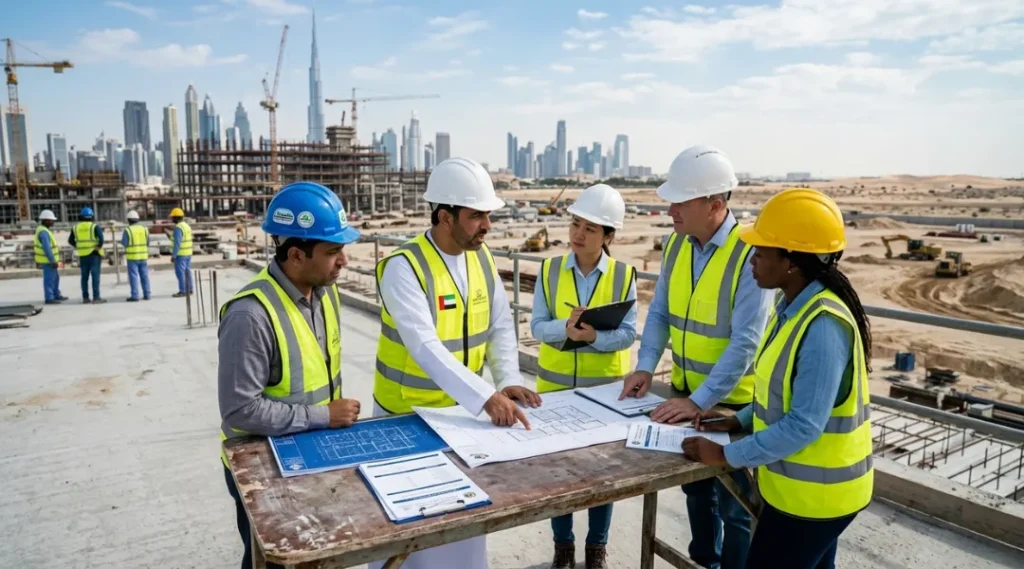
For workers in India, UAE, and Saudi Arabia applying for jobs on international construction and oil and gas projects, OSHA 10 is increasingly listed alongside NEBOSH and IOSH as a preferred credential. Gulf-based EPC contractors regularly shortlist candidates with OSHA Outreach cards for safety officer assistant and HSE trainee roles.
4. Creates a foundation for safety career advancement
OSHA 10 is the first rung of a professional ladder. Workers who complete OSHA 10 have a clear path to OSHA 30, specialized training (HAZWOPER, fall protection), and eventually Safety Officer Certification or NEBOSH qualifications. In my experience, workers who skip the foundational credential and go straight to OSHA 30 often discover gaps in basic hazard recognition that cause them to struggle in the advanced material.
When It Doesn’t Work
OSHA 10 is not right for every situation. If your employer requires OSHA 30 for supervisory roles, completing OSHA 10 first is a reasonable pathway, but it will not substitute for the 30-hour requirement. If you need task-specific authorization: forklift operation, confined space rescue, or HAZWOPER. OSHA 10 alone will not fulfill those requirements. And if your project is located in a state without a mandate, some employers may not value the credential as much as others do. Understand the specific requirements of your target employer or project before enrolling.
Common OSHA 10 Mistakes to Avoid
The most common mistake is enrolling through a non-authorized provider, which results in a card that employers and state agencies will reject. The second most common mistake is choosing the wrong industry track, construction vs. general industry, which means the training may not satisfy your specific employer or site requirement.
Mistake 1: Using a non-authorized provider
This is the most costly mistake. Some websites sell ‘OSHA 10 certificates’ that are not issued by OSHA-authorized trainers. These certificates are not valid for site access, state compliance, or employer requirements. Always verify your provider on OSHA’s published list of authorized online providers before enrolling. If a provider is not on that list, their card is worthless regardless of how convincing their website looks.
Real-world example: in 2023, a New York job site removed 12 workers after a compliance inspection revealed their OSHA 10 cards were issued by a non-authorized online vendor. All 12 had to re-enroll with an authorized provider at their own expense.
Mistake 2: Choosing the wrong industry track
A Construction card does not satisfy General Industry requirements, and vice versa. OSHA inspectors and compliance officers know the difference. If your jobsite is a manufacturing plant and you present a Construction track card, the card will likely not satisfy the site’s safety compliance records.
Mistake 3: Rushing through the course for the card
Online course platforms track your progress and completion time. Providers are required to enforce minimum contact hours. Beyond compliance, workers who rush the material miss the actual point: OSHA 10 teaches you to see hazards. If you spend the entire course clicking through slides, you’ll have a card but not the knowledge. That knowledge gap shows up quickly on a real job site.
Mistake 4: Confusing OSHA 10 with a professional license
OSHA explicitly states that the Outreach card is not a certification, license, or professional credential in the traditional sense. It is a course completion record. Some employers, particularly in states with mandates, treat it as a required document. Others treat it as a preferred but not mandatory credential. Know how your specific employer or target project treats the card before building career decisions around it.
Mistake 5: Not keeping a digital copy of the card
Physical cards get lost. OSHA says replacement depends on the original trainer and a five-year lookback window for 10- and 30-hour courses. Some providers can reissue cards; others cannot. Photograph your card the day it arrives and save it in cloud storage. This takes 30 seconds and can save significant administrative headaches later.
Frequently Asked Questions About OSHA 10-Hour Training
OSHA 10-hour training is voluntary at the federal level but mandatory in several US states for specific project types. Connecticut, Missouri, Nevada, New York, and Rhode Island require OSHA 10 for workers on certain public construction projects. Many private contractors and general contractors also require it as a condition of subcontractor qualification, making it effectively mandatory for those who want to work on those sites.
OSHA 10 requires a minimum of 10 contact hours. Online providers let you work at your own pace across multiple sessions, but the total training time still meets the 10-hour minimum requirement. Most learners spread completion over 2 to 5 days. Card delivery takes up to 90 days after completion, though most authorized providers process cards within 2 to 6 weeks.
OSHA 10-hour training typically costs between $59 and $79 through major authorized US providers. International training providers may price differently based on market and support level. Avoid providers charging significantly less than this range, as they are often not OSHA-authorized. There is no legitimate free OSHA 10 course that results in a valid DOL completion card.
Yes. OSHA formally authorized online Outreach training in 2020, and cards from authorized online providers are identical to those from in-person programs. The key requirement is that the provider must be on OSHA's published authorized list. Employers cannot legally distinguish between online and in-person OSHA 10 cards if both come from authorized providers.
OSHA 10 cards do not have an official expiration date printed on them. However, some states and employers set informal renewal expectations, typically every 3 to 5 years. New York, for example, recognizes cards within a 5-year lookback for replacement purposes. Workers in rapidly evolving regulatory environments are advised to refresh their training every 3 to 5 years to stay current with updated OSHA standards.
OSHA 10 is recognized by many international employers, particularly in construction, oil and gas, and infrastructure sectors across the Gulf region, Southeast Asia, and Canada. It is not a universal international credential, since countries have their own regulatory frameworks, but it is widely understood as a signal of foundational hazard training. Workers in India, UAE, and Saudi Arabia frequently list OSHA 10 alongside NEBOSH and IOSH credentials.
OSHA 10 is a 10-hour entry-level course for workers with basic safety responsibilities. OSHA 30 is a 30-hour course for supervisors, foremen, site safety officers, and workers with significant safety management duties. OSHA 30 goes deeper into hazard analysis, safety program management, and regulatory compliance. Workers seeking leadership or supervisory roles should target OSHA 30 as their next credential after completing OSHA 10.
Yes. OSHA-authorized online providers are accessible from anywhere in the world with an internet connection. Workers in India, UAE, Saudi Arabia, Malaysia, Canada, and the UK can complete OSHA 10 online and receive a valid DOL completion card. M2Y Global Academy / M2Y Safety Consultancy provides OSHA 10 training specifically designed for international learners, with career support tailored to the safety job markets in those regions.
What to Learn Next
If this guide answered your OSHA 10 questions, here are the logical next steps in your OSHA training journey:
- OSHA 10 vs OSHA 30: Which One Should You Choose? A detailed decision guide for workers deciding whether to upgrade to the 30-hour course.
- OSHA 30-Hour Training Course: Complete Guide. Covers the full OSHA 30 curriculum, cost, who it’s for, and how to enroll.
- OSHA Certification: The Complete Guide for 2026. How OSHA 10 fits into the broader OSHA certification landscape, including specialty certifications and career pathways.
- Safety Officer Certification: Career and Course Guide. For workers who want to understand the full safety career progression beyond OSHA 10.
- OSHA Training for India, UAE, and Saudi Arabia. Country-specific guides for international learners covering recognition, career impact, and local employer expectations.
Conclusion
Three things worth remembering from this guide:
- OSHA 10-hour training is an entry-level hazard awareness course: not a license, not a certification, and not a substitute for task-specific training. It is the first credential in a professional safety journey.
- Choosing the right provider matters more than most people realize. Only OSHA-authorized providers issue valid DOL cards. Non-authorized cards are rejected by employers, state agencies, and compliance officers. Verify before you enroll.
- The construction and general industry tracks are not interchangeable. Match your course to your workplace. A mismatched card can disqualify you from a specific project even if you are otherwise qualified.
OSHA 10-hour training is one of the most accessible, most recognizable safety credentials available, and it genuinely opens doors that would otherwise stay closed. Whether you’re an entry-level worker looking to meet site access requirements, a graduate starting a safety career, or an international professional building credentials for global projects, OSHA 10 is a practical, achievable, and worthwhile first step.
Ready to start? M2Y Global Academy offers OSHA 10 training specifically designed for international learners, with flexible online access, career support, and certifications recognized by employers in 30+ countries.