
OSHA Certification 2026
Quick Summary
- OSHA 10 is usually for entry-level workers.
- OSHA 30 is usually for supervisors or workers with safety responsibility.
- An OSHA card is not a license or universal certification.
- OSHA allows online Outreach training only through authorized providers.
- Many jobs still require extra employer-specific training beyond OSHA 10 or OSHA 30.
Table of Contents
Toggle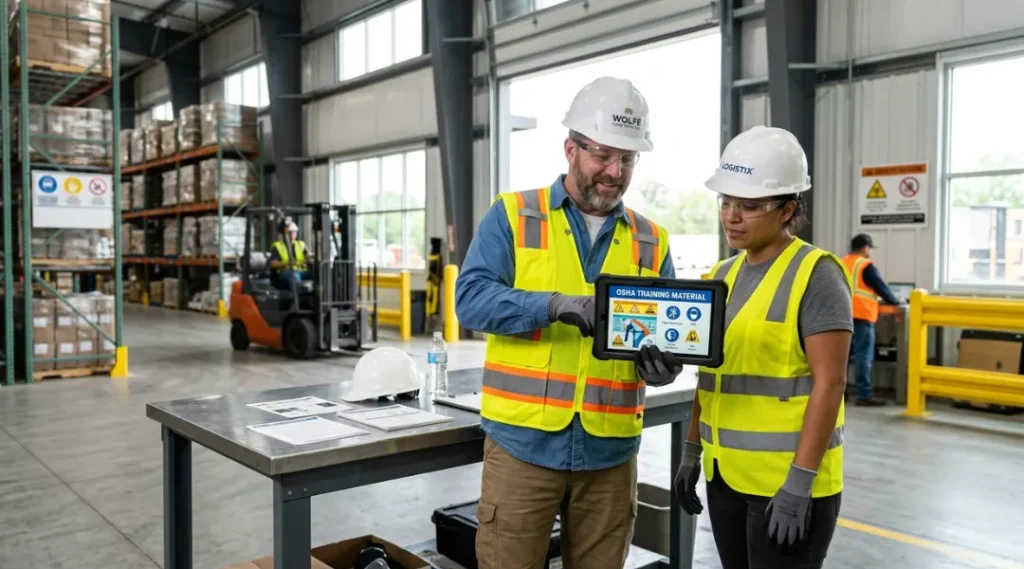
OSHA Certification is the common search term people use for OSHA safety training, especially OSHA 10-hour and 30-hour Outreach courses. It works by teaching hazard recognition, worker rights, employer responsibilities, and complaint procedures. Unlike a trade license, it usually results in a course completion card, not a universal government-issued professional certification. Between FY 2021 and FY 2025, more than 6.51 million workers were trained through OSHA’s Outreach program.
What Is OSHA Certification?
OSHA Certification usually refers to OSHA Outreach training, but the exact term is often used loosely. In most cases, people mean OSHA 10 or OSHA 30 course completion. Officially, OSHA says an Outreach card is not a certification or license, even though employers and job seekers often use that wording in everyday conversation.
Here is the simplest way to think about it.
If you search for OSHA certification, you are usually looking for one of four things:
- OSHA 10-hour training for entry-level workers
- OSHA 30-hour training for supervisors or workers with safety duties
- Specialized hazard training such as HAZWOPER, fall protection, confined space, or forklift instruction
- Proof of training that helps meet employer, contractor, union, or local jobsite rules
That distinction matters. OSHA’s own guidance says Outreach training is a voluntary program that helps workers recognize hazards and understand their rights, but it does not replace training that OSHA standards require for specific hazards or equipment.
So when should you use the phrase “OSHA Certification” on the page? Use it because that is the keyword people search. Then explain the truth early. That gives you both SEO relevance and factual accuracy.
Why OSHA Certification Matters in 2026
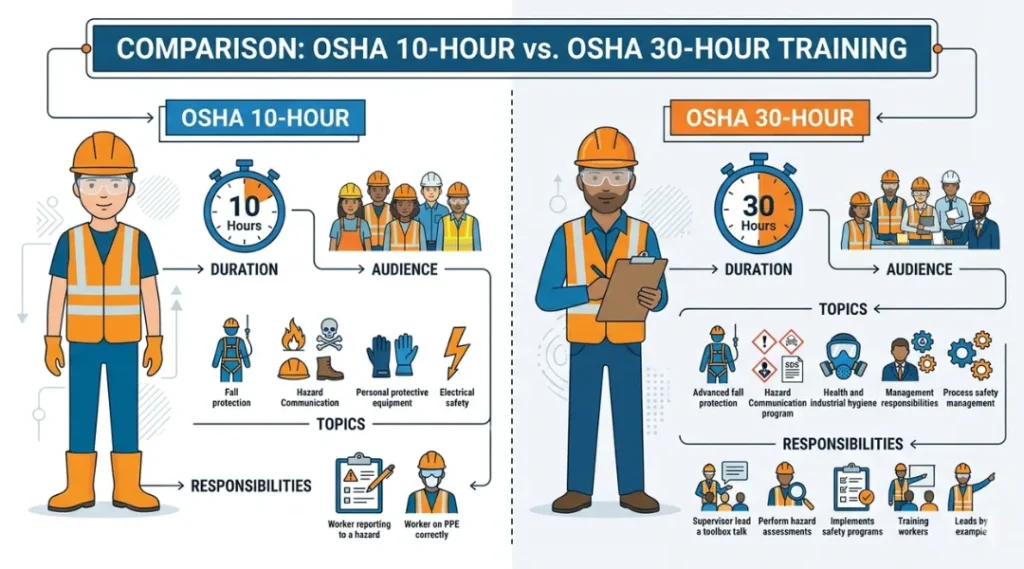
OSHA Certification matters in 2026 because employers still need workers who can recognize hazards quickly, many states and job owners enforce training expectations, and the labor market continues to reward safety knowledge. The keyword is popular for a reason: workers want safer jobs, faster hiring, and clearer proof of readiness.
The demand is not theoretical. OSHA says federal OSHA and its state partners have about 1,850 inspectors responsible for 130 million workers across more than 8 million worksites, or roughly one compliance officer per 70,000 workers. That means workplaces need stronger day-to-day safety habits before an inspection ever happens.
The enforcement side is also real. OSHA’s FY 2024 top-cited standards included:
- Fall Protection
- Hazard Communication
- Lockout/Tagout
- Ladders
- Respiratory Protection
- Powered Industrial Trucks
- Fall Protection Training
- Scaffolding
- Eye and Face Protection
- Machine Guarding
That list tells you something important. The most common hazards are not obscure. They are the same hazards workers see every day on construction sites, in warehouses, in plants, and in maintenance environments.
There is also a career angle. The Bureau of Labor Statistics says occupational health and safety specialists and technicians had a 2024 median pay of $78,900 and projected 12% job growth from 2024 to 2034, which is much faster than average. Safety literacy does not guarantee a higher salary on its own, but it clearly aligns with a labor market that values risk reduction and compliance competence.
One thing many guides miss is this: safety training is a bit like wearing a seatbelt. It does not prevent every crash, but it sharply improves your odds when things go wrong.
Types of OSHA Certification and Training
There is no single OSHA certification that fits every worker. The right training depends on your industry, your role, and your exposure to specific hazards. OSHA 10 and OSHA 30 cover broad hazard awareness, while specialty training applies to equipment, environments, and high-risk tasks.
OSHA 10-Hour Certification
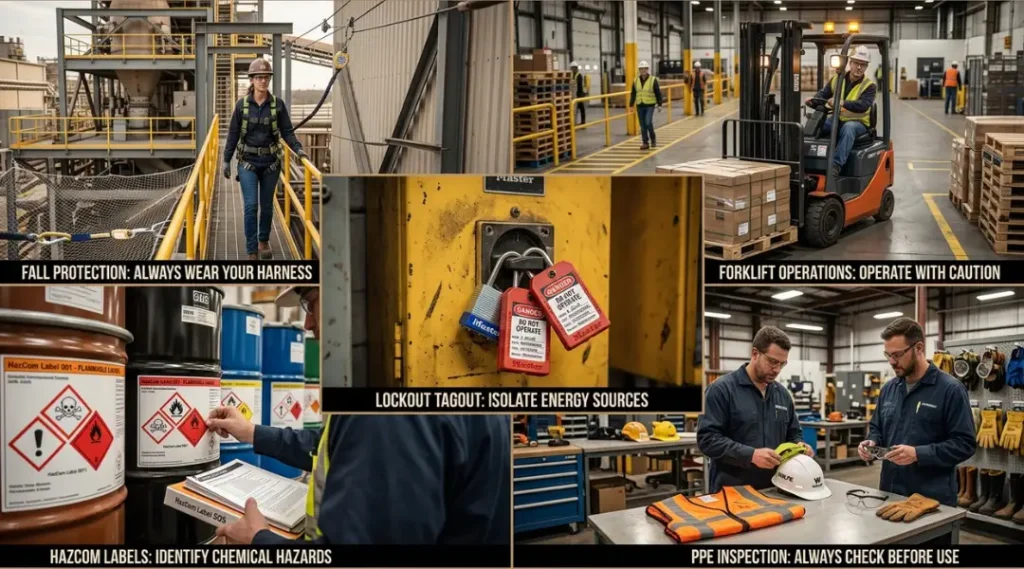
OSHA says the 10-hour class is intended to provide workers with awareness of common job-related hazards. It is primarily designed for entry-level workers. That makes it a strong fit for helpers, laborers, warehouse associates, technicians, and new hires.
OSHA 30-Hour Certification
OSHA says the 30-hour class is more appropriate for supervisors or workers with some safety responsibility. It goes deeper, covers more topics, and is the better choice for foremen, team leads, site supervisors, and safety coordinators.
Construction vs General Industry
OSHA offers Outreach courses for Construction, General Industry, Maritime, and Disaster Site Worker programs. Construction typically aligns with site trades, labor, and field operations. General Industry usually fits factories, warehouses, healthcare settings, logistics, and maintenance environments.
Specialty OSHA Safety Certification
Some jobs need much more than OSHA 10 or OSHA 30.
For example:
- Forklift operators must be trained and certified by their employers under OSHA’s powered industrial truck rules. That certification is organization-based, not a general OSHA 10 card.
- HAZWOPER can require written certificates for 8-, 24-, or 40-hour training, depending on the role and exposure. Many workers in hazardous waste operations need 24 or 40 hours plus additional field experience.
- Fall protection training is required for exposed workers, and the employer must ensure training is delivered by a competent person and documented appropriately.
This is where many people get confused. OSHA 10 and OSHA 30 are the front door. Specialty training is the room you actually need for certain jobs.
How to Get OSHA Certified Step by Step
To get OSHA certified in the way most job seekers mean it, you need to choose the right industry track, take the correct Outreach course from an authorized trainer or provider, complete all required hours, and then wait for your course completion card. The key is choosing the right training path before you enroll.
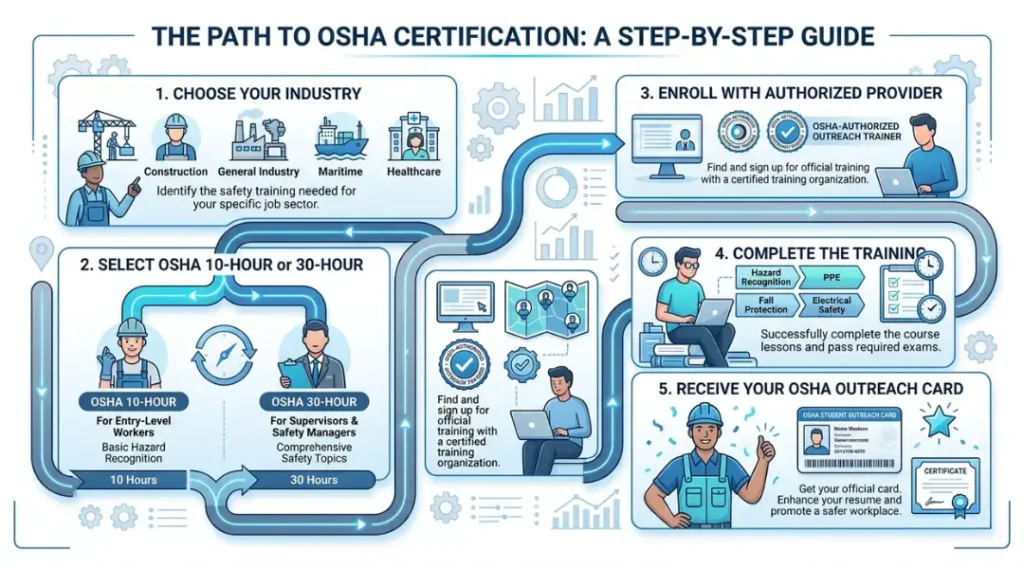
Step 1: Choose the right industry
Start by matching the course to your job.
- Construction for jobsite trades and field labor
- General Industry for factories, warehouses, healthcare, manufacturing, and similar workplaces
- Maritime for marine-related operations
- Disaster Site Worker for disaster response support roles
If you choose the wrong industry, the course may still teach useful concepts, but it may not satisfy what your employer or project owner expects.
Step 2: Decide between OSHA 10 and OSHA 30
Pick OSHA 10 if you are new to the field or need baseline hazard awareness. Pick OSHA 30 if you supervise others or carry safety responsibility. OSHA itself makes that distinction clearly.
Step 3: Use an authorized trainer or online provider
OSHA allows online Outreach training only through authorized providers. OSHA also publishes the current authorized provider list, which includes organizations such as 360Training, ClickSafety, CareerSafe, HSI, UL Solutions, RedVector, and the University of South Florida for certain course types.
Step 4: Complete the full course
To obtain an OSHA card, the student must successfully complete the entire class, including the required topics and the minimum contact hours. There is no shortcut here. If it says 10 hours or 30 hours, you need to complete that training time.
Step 5: Receive your card
OSHA says Outreach trainers must issue student course completion cards directly to the student within 90 days of course completion. If you do not receive it, contact the trainer or provider. OSHA also says it does not maintain a national database for verifying student cards.
One practical tip: keep a digital copy of your certificate of completion and a photo of the card as soon as it arrives. Replacement options are limited, and OSHA says replacement cards generally depend on the original trainer and a five-year lookback for 10- and 30-hour cards.
OSHA Certification Cost and How Long It Takes
OSHA certification cost usually falls into a predictable range for Outreach courses: around $60 for most OSHA 10 online courses and around $160 for most OSHA 30 online courses. The time commitment is straightforward, because the course hours reflect the minimum contact time you must actually complete.
Typical cost ranges
Current public pricing examples from OSHA-authorized providers show a fairly tight range:
| Course | Typical online price range | Notes |
|---|---|---|
| OSHA 10 Construction | $59 to $60 | Entry-level construction awareness |
| OSHA 10 General Industry | $59 to $60 | Entry-level general industry awareness |
| OSHA 30 Construction | $159 to $160 | Deeper construction safety training |
| OSHA 30 General Industry | $159 to $160 | Deeper general industry training |
These figures align with public pricing from 360Training, ClickSafety, CareerSafe, and OSHA Education Center course pages.
How long does OSHA certification take?
The answer is simpler than many people expect.
- OSHA 10 takes a minimum of 10 contact hours
- OSHA 30 takes a minimum of 30 contact hours
- Card delivery can take up to 90 days after completion
That does not mean you have to finish it in one sitting. Many online providers let you work at your own pace. But the total required training time still applies.
Is free OSHA certification online realistic?
Usually, no. OSHA publishes free resources, publications, and training materials, but official OSHA Outreach cards come through authorized trainers or authorized online providers, and those courses generally cost money. If a site promises a free official OSHA 10 or OSHA 30 card, treat that as a red flag.
Best OSHA Certification Online Options
The best OSHA certification online option is the one that is authorized, matches your industry, fits your budget, and gives you a valid course completion path. Start with OSHA’s own authorized provider list, then compare price, course format, support, and whether the provider offers your exact industry track.
| Provider | Best For | Key Feature | Price Range | Limitation |
|---|---|---|---|---|
| 360Training | Budget-focused individuals | Broad online catalog, construction and general industry | $59.99 / $159.99 | Self-paced format may not suit everyone |
| ClickSafety | Learners who want established safety brand recognition | Strong construction presence | $59 / $159 sale pricing | Pricing may vary with promotions |
| CareerSafe | Students and schools | Youth focus and education pricing | $59 individual, lower school pricing | More education-oriented positioning |
| OSHA Education Center | Straightforward online purchase flow | Clear public pricing by course | $59 / $159 | Brand name can confuse users into thinking it is OSHA itself |
Public pricing and provider status should always be checked before publishing or enrolling, because sales and course availability can change. OSHA’s authorized provider list is the source of truth for legitimacy.
A simple rule works well here. If you need speed and low cost, compare 360Training and ClickSafety first. If you are a student or school program, CareerSafe deserves a close look. If you want a very simple catalog and checkout flow, OSHA Education Center is easy to understand. But in every case, confirm the provider is still on OSHA’s current authorized list before you buy.
Benefits of OSHA Certification
OSHA Certification can improve hazard awareness, strengthen employability, support compliance culture, and help workers communicate more confidently about safety. Its biggest value is not the card itself. The value is what the training helps you notice before an incident happens.
1. Better hazard recognition
OSHA says Outreach training focuses on the recognition, avoidance, abatement, and prevention of workplace hazards. That matters because the most cited standards still involve common, repeat hazards like falls, hazard communication, and lockout/tagout.
2. Stronger job readiness
Many employers, unions, municipalities, and project owners require OSHA training even though OSHA itself does not universally require OSHA 10 or OSHA 30. That means the card often works as a hiring filter.
3. Better path into safety-focused careers
Workers who move into safety roles benefit from formal safety literacy. BLS reports a 2024 median pay of $78,900 for occupational health and safety specialists and technicians, with 12% projected job growth through 2034.
4. Clearer understanding of rights and responsibilities
Outreach training includes worker rights, employer responsibilities, and how to file a complaint. That is especially important in workplaces where workers are new, multilingual, or unsure how to raise concerns.
When it does not work
OSHA Certification does not work as a substitute for specialized or employer-specific training. It also does not function as a trade license, a universal legal clearance, or a guarantee of job placement. If a worker needs forklift authorization, fall protection training, or HAZWOPER field preparation, OSHA 10 or OSHA 30 alone will not cover that gap.
Common OSHA Certification Mistakes to Avoid
The most common mistake is assuming an OSHA card solves every training requirement. That misunderstanding causes hiring delays, failed compliance expectations, and wasted money on the wrong course. Most problems start when people treat the keyword “OSHA certification” as more precise than it really is.
1. Thinking OSHA 10 or 30 is a license
It is not. OSHA states that an Outreach card is not considered a certification or license. Use the keyword for SEO, but explain the terminology honestly on the page.
2. Choosing the wrong industry
Construction and General Industry are not interchangeable. A warehouse worker taking Construction training may still learn useful concepts, but the employer may expect General Industry content instead.
3. Buying from a non-authorized provider
OSHA says it cannot validate online training from vendors outside its authorized list. That is the fastest way to waste money.
4. Assuming OSHA 10 replaces specialty training
Forklift operators, HAZWOPER workers, and fall-exposed workers often need separate, specific training and documentation. OSHA 10 is awareness training, not the whole compliance package.
5. Losing the card and expecting OSHA to replace it directly
OSHA says it does not keep student records for Outreach classes and cannot issue replacement cards itself. You usually need the original trainer or provider.
Usually not. OSHA says Outreach training is voluntary and that OSHA 10- and 30-hour courses are not generally required by OSHA itself. However, some states, municipalities, employers, unions, and project owners do require them as a condition of work or site access.
OSHA 10 is intended for entry-level workers who need basic hazard awareness. OSHA 30 is intended for supervisors or workers with some safety responsibility and covers a wider range of topics in more depth.
Yes, but only through OSHA-authorized online Outreach providers. OSHA publishes the current provider list and advises students to compare vendors there rather than trusting unlisted websites.
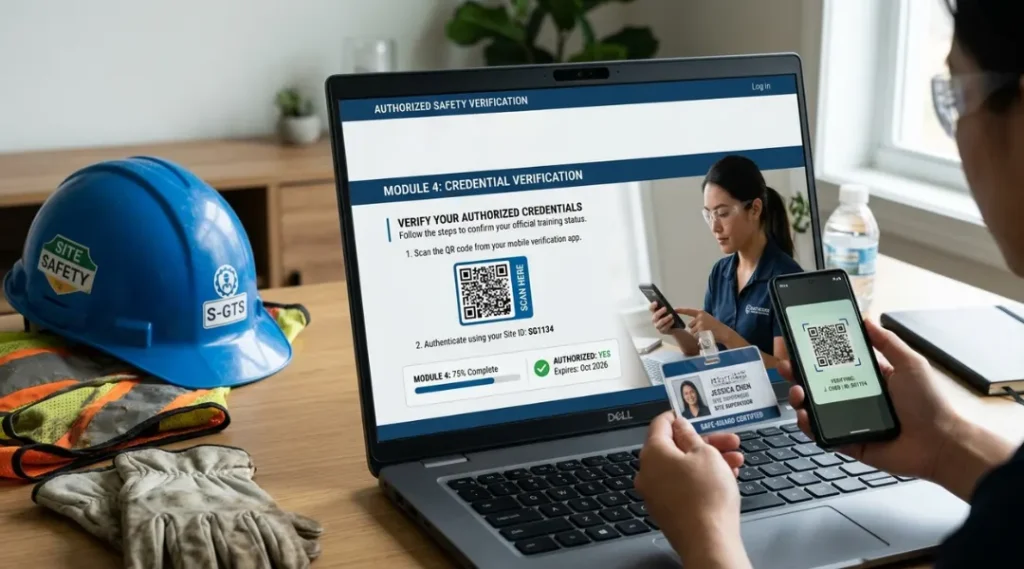
OSHA says plastic Outreach cards can be verified by scanning the QR code on the back. OSHA also says it does not operate a national database website for verifying paper or plastic student cards.
For standard 10- and 30-hour Outreach cards, OSHA does not set a universal expiration for employment use, but employers or local rules may impose their own freshness requirements. Maritime card rules are different: cards issued after April 1, 2019 do not expire.
Not in the way most people mean it. OSHA offers free safety resources and publications, but official Outreach training that leads to an OSHA 10 or OSHA 30 card normally comes through authorized providers that charge for the course.
OSHA says Outreach trainers are required to issue student course completion cards within 90 days of class completion. If your card has not arrived by then, contact your trainer or provider directly.
OSHA is a U.S. workplace safety framework, so its legal relevance is strongest in the United States and in U.S.-linked job requirements. International employers may still value the training, but acceptance outside U.S. OSHA jurisdiction depends on the employer, project, and country-specific rules. This is an inference based on OSHA’s jurisdiction model and state plan structure.
What to Learn Next
- OSHA 10 Certification: Who Needs It and What It Covers
- OSHA 30 Hour Certification: Best Choice for Supervisors
- OSHA Certification Cost: Full Breakdown by Course Type
- OSHA Certification Online: How to Choose a Legit Provider
- Forklift Certification vs OSHA 10: What Is the Difference?
Conclusion
If you want the simplest possible takeaway, here it is:
- OSHA Certification usually means OSHA Outreach training, not a professional license.
- OSHA 10 is for entry-level awareness, while OSHA 30 is better for supervisors and safety responsibility.
- The right course is only useful if it is authorized, industry-matched, and combined with any specialty training your job actually requires.