
Safety Officer Certification 2026
Key Takeaways |
Safety officer certification refers to the formal credentials that qualify a professional to oversee workplace health and safety. The most recognized certifications globally are OSHA 30-Hour, NEBOSH IGC, IOSH Managing Safely, CSP, and OTHM Level 6. Safety officer roles are in demand across construction, oil and gas, manufacturing, and healthcare in 30+ countries. Starting salaries range from INR 420,000 in India to AED 120,000+ in UAE and USD 65,000+ in the US. M2Y Global Academy / M2Y Safety Consultancy provides affordable safety officer certification courses recognized by employers across India, UAE, Saudi Arabia, Malaysia, Canada, US, the UK, and worldwide. |
Table of Contents
Toggle
Every year, over 2.3 million people die from work-related accidents or diseases globally, according to the International Labour Organization (ILO, 2023). Behind every employer that beats those odds is a safety officer who knew what to look for before an incident happened.
Safety officer certification is not just a career credential. It is the formal proof that a professional has the knowledge, skills, and recognized training to protect workers, manage compliance, and reduce organizational risk. The demand for qualified safety officers has never been stronger, and the range of recognized certifications has never been more international.
Whether you are a fresh graduate looking to enter the safety field, a site supervisor ready to formalize your skills, or an experienced professional targeting your next role in UAE, Saudi Arabia, Canada, or the UK, this guide covers everything you need to know about safety officer certification in 2026: what the job actually involves, which credentials matter, how much you can earn, and the clearest path from where you are now to where you want to be.
Safety officer certification is the formal recognition that a professional has completed accredited training in occupational health and safety, workplace hazard management, and regulatory compliance. It works by combining structured coursework, assessments, and in some cases practical experience to qualify the holder for safety oversight roles across industries including construction, oil and gas, manufacturing, and healthcare. Unlike informal on-the-job safety training, certified safety officers hold credentials recognized by employers, regulators, and international project owners. As of 2026, demand for certified safety professionals is growing at 12% per year globally, driven by stricter regulation and rising employer liability awareness (BLS, 2024).
What Does a Safety Officer Do?
A safety officer identifies, evaluates, and controls workplace hazards to prevent injuries, illnesses, and fatalities. Core responsibilities include conducting site inspections, delivering safety inductions, investigating incidents, maintaining compliance records, and training workers in safe practices. The role spans every major industry and operates at the intersection of people management, regulatory compliance, and practical risk reduction.
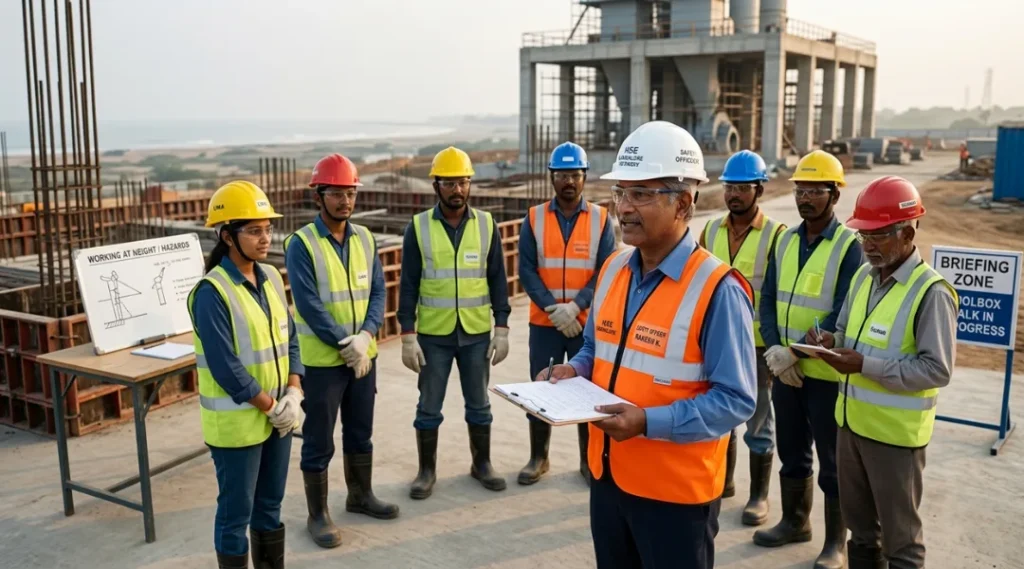
The title varies by country and industry. Safety officer, HSE officer, health and safety advisor, EHS coordinator, and occupational safety specialist all describe professionals doing fundamentally similar work. What they share is the responsibility of being the person on site or in the facility who makes sure safety standards are actually followed, not just posted on a wall.
Core daily responsibilities
- Conducting pre-shift and routine site safety inspections
- Identifying hazards and issuing corrective action notices
- Delivering toolbox talks and safety inductions to new and existing workers
- Investigating accidents, near-misses, and dangerous occurrences
- Maintaining safety documentation: risk assessments, method statements, permit-to-work logs
- Ensuring PPE is available, used correctly, and maintained
- Liaising with management, supervisors, and regulatory bodies on safety matters
- Preparing and updating emergency response plans and evacuation procedures
- Tracking incident rates, safety performance KPIs, and audit outcomes
- Staying current with updated OSHA, NEBOSH, IOSH, and local regulatory requirements
A day in the life of a safety officer
Morning typically starts with a site walk or facility inspection before work begins. A construction safety officer might check scaffold erection, verify fall protection is in place, and review the day’s permit-to-work log. A manufacturing HSE officer might audit chemical storage areas, check lockout/tagout procedures are being followed, and review the previous shift’s near-miss reports.
Mid-morning often involves documentation: updating risk assessments, recording inspection findings, and preparing a toolbox talk for the afternoon. The afternoon might include a toolbox talk with a crew, a follow-up inspection on a previously identified hazard, or an incident investigation if something went wrong on the previous shift.
What people outside the safety field often underestimate is how much of the role is communication. The best safety officers I have worked with spend as much time talking to workers and supervisors as they do writing reports. A hazard you spot and fix before it causes an incident never shows up in the statistics, which is both the challenge and the reward of the role.
How to Become a Safety Officer
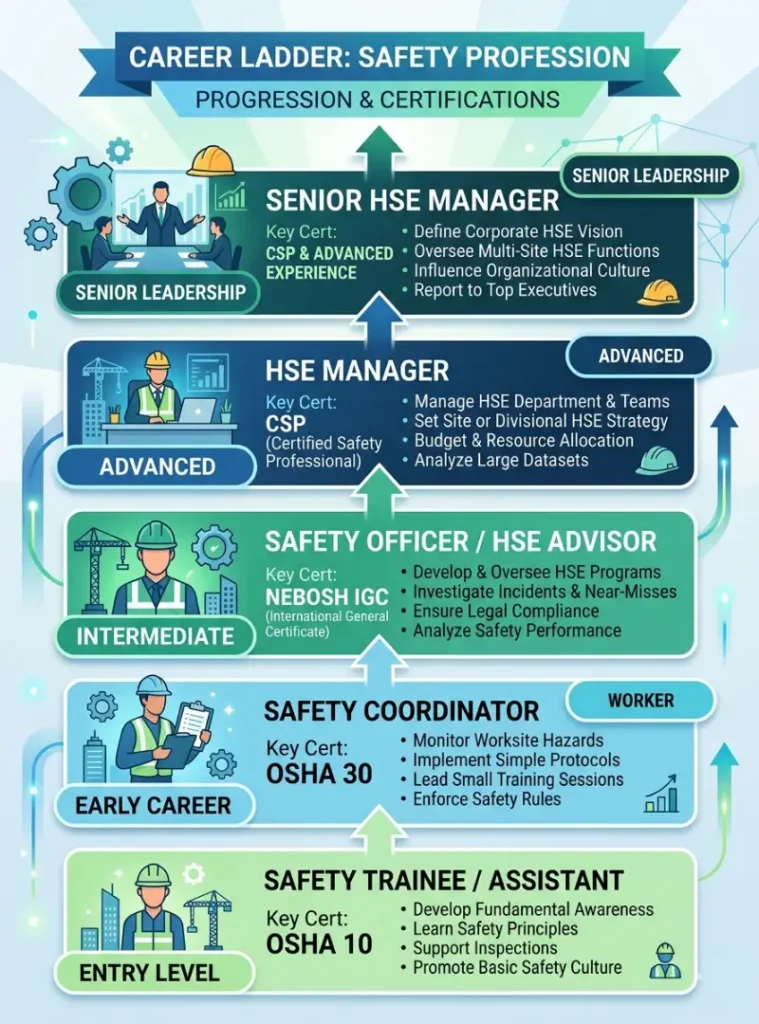
Becoming a safety officer requires completing recognized safety certifications, gaining practical workplace experience, and building knowledge of the regulatory framework that applies to your target industry and country. Most entry-level safety officer roles require a minimum of OSHA 30 or NEBOSH IGC plus some practical experience. Senior roles typically require CSP, NEBOSH Diploma, or equivalent advanced credentials.
Step 1: Understand the qualification pathway for your target market
Different countries and industries weight credentials differently. Before enrolling in any course, research the specific requirements for the roles you are targeting. Job postings in UAE typically list NEBOSH IGC and IOSH Managing Safely as minimum requirements. Job postings in India often list OSHA 30 or NEBOSH alongside a bachelor’s degree. US roles in construction frequently list OSHA 30 as mandatory with CSP preferred for senior positions. Start with the market, then choose the credential.
Step 2: Complete your foundational safety certification
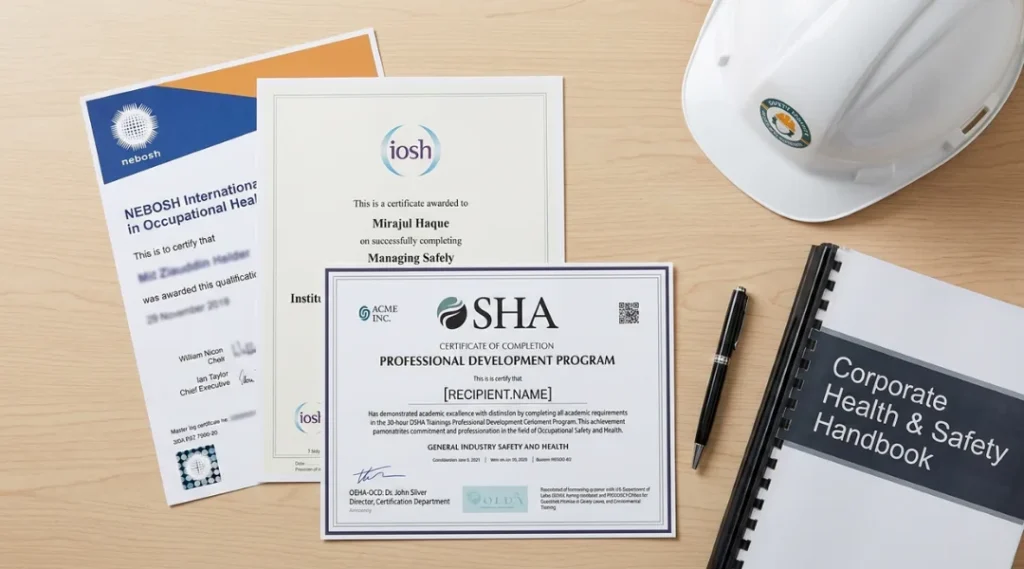
Most safety officers start with one of two foundational credentials: OSHA 30-hour training for construction and general industry roles, or NEBOSH International General Certificate (IGC) for roles in the UK, Middle East, and internationally regulated environments. These credentials serve different markets but achieve the same foundational goal: proving you have structured safety training that an employer can verify.
IOSH Managing Safely is a strong alternative entry point for workers whose employers are IOSH-affiliated or who are targeting UK or Ireland roles. It is shorter than NEBOSH IGC but widely recognized at the supervisory level.
Step 3: Gain practical experience
Most recognized safety credentials require or strongly recommend practical workplace experience. NEBOSH IGC, for example, includes a practical assessment element. For the CSP (Certified Safety Professional), BCSP requires demonstrated safety experience before you are eligible to sit the exam. Entry-level safety roles, safety trainee positions, or working as a safety assistant alongside a certified officer all count toward building the practical portfolio employers expect.
Step 4: Specialize for your industry
General safety credentials open doors. Industry-specific knowledge keeps them open. A safety officer in oil and gas needs HAZWOPER knowledge and process safety understanding. One in construction needs hands-on knowledge of fall protection, scaffold inspections, and excavation safety. Healthcare safety officers need bloodborne pathogen training and OSHA General Industry standards. Specialty training layered on top of your core credential is what makes your application stand out.
Step 5: Pursue advanced certification for senior roles
If your goal is a safety manager, HSE director, or senior consultant role, foundational credentials are the floor, not the ceiling. Advanced credentials to target include the CSP (Certified Safety Professional), NEBOSH International Diploma, OTHM Level 6 in Occupational Health and Safety, or ProQual NVQ equivalents. At M2Y Global Academy / M2Y Safety Consultancy, we offer structured progression pathways from OSHA 30 through NEBOSH IGC to advanced diplomas, so learners can build credentials in a planned sequence rather than randomly adding qualifications that do not connect.
Best Safety Officer Certifications in 2026
The best safety officer certification depends on your target country, industry, and career level. OSHA 30 is the baseline for construction and general industry roles in the US and internationally. NEBOSH IGC is the dominant credential for Middle East, UK, and internationally regulated roles. IOSH Managing Safely suits supervisory positions. CSP is the gold standard for senior US roles. OTHM Level 6 is valued for management-track careers.
Certification | Awarding Body | Level | Best Market | Duration | Price Range (USD/AED/INR) | Recognition |
OSHA 30-Hour | US DOL / OSHA | Supervisory | US, Gulf, SE Asia, India | 30 hours online | USD $59-$79 / AED 220-290 / INR 4,900-6,600 | Strong globally for construction and oil and gas |
NEBOSH International General Certificate (IGC) | NEBOSH UK | Foundation | UK, UAE, Saudi, India, Malaysia | 10-12 weeks part-time | USD $400-$800 / AED 1,470-2,940 / INR 33,000-66,000 | Highest recognition in Gulf and UK markets |
IOSH Managing Safely | IOSH UK | Supervisory | UK, Ireland, Gulf, SE Asia | 3-5 days or online | USD $250-$450 / AED 920-1,650 / INR 21,000-37,000 | Widely accepted at supervisory level across UK and Gulf |
Certified Safety Professional (CSP) | BCSP USA | Advanced | US, Canada, internationally recognized | Exam-based, experience required | USD $500-$800 / AED 1,835-2,940 / INR 42,000-66,000 | Gold standard for senior US safety roles |
OTHM Level 6 Diploma in OHS | OTHM UK / Ofqual | Management | UK, UAE, India, Malaysia | 6-12 months | USD $600-$1,200 / AED 2,200-4,400 / INR 50,000-100,000 | Strong for management-track and UK regulated roles |
OSHA 10-Hour | US DOL / OSHA | Entry | US, Gulf, SE Asia | 10 hours online | USD $59-$79 / AED 220-290 / INR 4,900-6,600 | Entry-level credential; stepping stone to OSHA 30 |
IOSH Working Safely | IOSH UK | Awareness | UK, Gulf, India, international | 1 day or online | USD $100-$200 / AED 370-735 / INR 8,300-16,600 | Awareness level; not a standalone safety officer credential |
A note on choosing between these credentials: they are not mutually exclusive. The strongest safety officer profiles in competitive markets combine credentials. The most common high-impact combination in the Gulf and international construction markets is OSHA 30 plus NEBOSH IGC. For workers targeting UK regulated environments, NEBOSH National General Certificate plus IOSH membership is the standard track. At M2Y Global Academy / M2Y Safety Consultancy, we design combined learning pathways so you can pursue multiple credentials in a structured, cost-effective sequence.
Safety Officer Course Eligibility and Requirements
Most foundational safety officer courses have no strict educational prerequisites, making them accessible to workers at various career stages. OSHA 30 requires no prior safety training. NEBOSH IGC recommends basic literacy and numeracy. CSP requires a degree and documented safety experience. Country-specific safety officer licenses may carry additional educational and experience requirements set by national regulators.
Certification | Educational Requirement | Experience Requirement | Language Requirement | Age Requirement |
OSHA 30-Hour | None | None required | English (courses available) | None stated by OSHA |
NEBOSH IGC | None formally; literacy and numeracy expected | None formally required | English (some translated exams available) | No minimum age stated |
IOSH Managing Safely | None | None; suitable for all levels | English | No minimum stated |
CSP | Bachelor’s degree preferred; associate pathway exists | 3-5 years documented safety experience | English | 18+ |
OTHM Level 6 | Level 4/5 qualification or relevant work experience | Relevant work experience in safety | English | 18+ |
Fresh graduates often worry that they lack the experience to start safety officer training. For foundational credentials like OSHA 30 and NEBOSH IGC, that concern is unnecessary. Both courses are designed to teach safety knowledge, not to test pre-existing expertise. You bring the willingness to learn; the course builds the competence. Experience requirements only become relevant when you progress toward advanced credentials like CSP or senior management diplomas.
Safety Officer Salary by Country
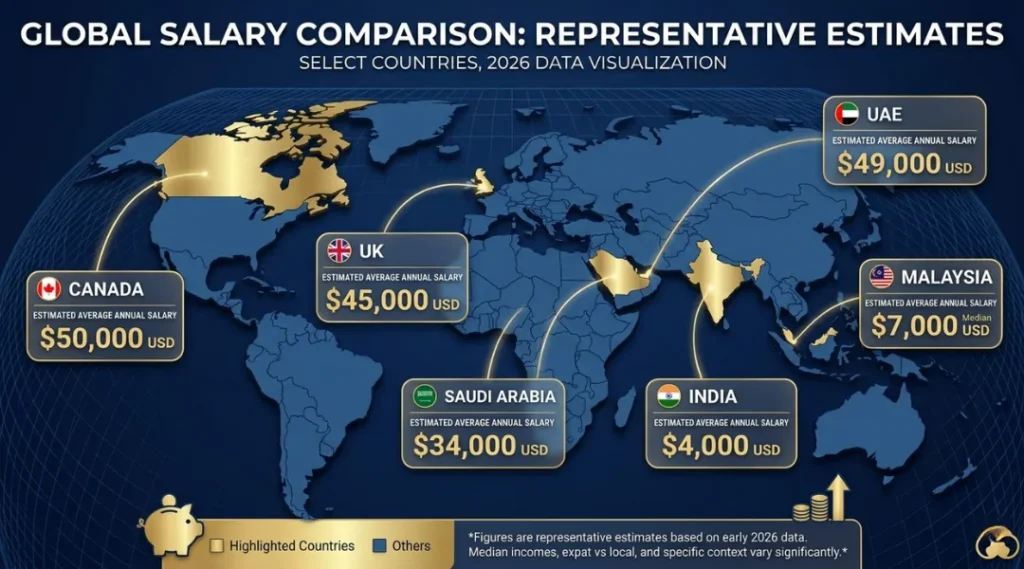
Safety officer salaries range from INR 300,000 per year at entry level in India to AED 180,000 or more for experienced HSE managers in the UAE. Salary varies by country, industry, experience level, and certification held. Workers with NEBOSH IGC plus OSHA 30 or CSP consistently command the highest salaries in their respective markets. Oil and gas remains the highest-paying sector globally for safety professionals.
Country | Level | Annual Salary Range | Currency Equivalent (USD) | Top-Paying Sector |
India | Entry (0-2 years, OSHA 30) | INR 300,000-480,000 | USD 3,600-5,800 | Oil and gas, construction |
India | Mid (3-7 years, NEBOSH IGC) | INR 480,000-960,000 | USD 5,800-11,500 | Infrastructure, manufacturing |
India | Senior (8+ years, NEBOSH Dip / CSP) | INR 960,000-2,000,000+ | USD 11,500-24,000+ | Petrochemical, EPC |
UAE / GCC | Entry (OSHA 30 / IOSH) | AED 36,000-60,000 | USD 9,800-16,300 | Construction |
UAE / GCC | Mid (NEBOSH IGC) | AED 72,000-120,000 | USD 19,600-32,700 | Oil and gas, infrastructure |
UAE / GCC | Senior (NEBOSH Dip / CSP) | AED 120,000-210,000+ | USD 32,700-57,000+ | Offshore, ADNOC contractors |
Saudi Arabia | Entry-Mid (OSHA 30) | SAR 36,000-72,000 | USD 9,600-19,200 | Construction |
Saudi Arabia | Mid-Senior (NEBOSH IGC+) | SAR 72,000-180,000 | USD 19,200-48,000 | Aramco and EPC contractors |
United Kingdom | Entry (IOSH MS / NEBOSH NGC) | GBP 25,000-35,000 | USD 31,000-44,000 | Construction, utilities |
United Kingdom | Senior (NEBOSH Dip / CMIOSH) | GBP 45,000-70,000+ | USD 56,000-88,000+ | Energy, manufacturing |
Canada | Entry (OSHA 30 / NCSO) | CAD 50,000-65,000 | USD 37,000-48,000 | Construction, mining |
Canada | Senior (CSP / CRSP) | CAD 80,000-120,000+ | USD 59,000-89,000+ | Oil sands, utilities |
Malaysia | Entry (OSHA 30 / SHO cert) | MYR 24,000-42,000 | USD 5,100-8,900 | Construction, manufacturing |
Malaysia | Senior (NEBOSH IGC+) | MYR 60,000-100,000+ | USD 12,700-21,200+ | Oil and gas, petrochemical |
United States | Entry (OSHA 30) | USD 45,000-65,000 | USD 45,000-65,000 | Construction, manufacturing |
United States | Senior (CSP) | USD 85,000-130,000+ | USD 85,000-130,000+ | Chemical, energy, defense |
The salary data above reflects 2024-2026 market conditions based on BLS Occupational Outlook Handbook (2024), Gulf safety job market surveys, Naukri and LinkedIn salary data for India, and industry benchmarking reports. These figures represent total compensation ranges and will vary by employer, project type, and individual negotiation. In oil and gas, allowances, accommodation, and transport benefits frequently add 30-50% to base salary packages in the Gulf region.
Safety Officer Jobs: Industries and Demand
Safety officers are employed across every major industry, but demand is highest in construction, oil and gas, manufacturing, and healthcare. Construction and oil and gas consistently offer the most international opportunities and the highest salaries. Healthcare safety is the fastest-growing sector in demand following post-pandemic regulatory changes. All major industry sectors are expected to increase safety hiring through 2034.
Construction
Construction is the largest employer of safety officers globally. OSHA data consistently identifies construction as the highest-risk sector for fatal work injuries in the US. The same pattern holds internationally. On large-scale infrastructure and building projects, the ratio of required safety officers to workers is often mandated by contract or regulation, creating consistent demand. For workers targeting international construction roles in UAE, Saudi Arabia, Qatar, and Canada, OSHA 30 is frequently the minimum required credential alongside a local or internationally recognized safety qualification.
Oil and Gas
Oil and gas is the highest-paying sector for safety professionals. Refineries, offshore platforms, petrochemical plants, and pipeline operations all carry extreme hazard profiles that require dedicated safety teams. Major oil companies and EPC contractors in the Gulf region, North Sea, and North America specify NEBOSH IGC, OSHA 30, and often HAZWOPER as minimum credentials for site safety roles. The combination of high risk, high consequence, and high regulatory scrutiny makes this sector the most demanding environment for safety officers and also the most rewarding financially.
Manufacturing
Manufacturing safety involves machine guarding, chemical handling, noise exposure, ergonomic risk, and process safety management. OSHA General Industry standards (29 CFR Part 1910) govern this environment in the US, while equivalent frameworks apply internationally. Demand is strong in automotive, food processing, pharmaceutical, and electronics manufacturing sectors. IOSH Managing Safely and OSHA 30 General Industry are the most common entry-level credentials sought by manufacturing employers.
Healthcare
Healthcare safety is growing faster than most other sectors, driven by post-pandemic regulatory tightening, infection control requirements, and increasing scrutiny of worker wellbeing in clinical environments. Healthcare safety officers manage biological hazards, ergonomic risks from patient handling, chemical exposure, and fire safety in complex facilities. OSHA General Industry standards apply in the US; NHS and Care Quality Commission frameworks govern UK healthcare environments.
Industry demand outlook
Industry | Demand Trend | Typical Credential Required | Key Regions |
Construction | High and stable; mandated ratios on large projects | OSHA 30, NEBOSH IGC, IOSH MS | US, UAE, Saudi Arabia, India, Canada, Malaysia |
Oil and Gas | Very high; premium salaries, competitive market | NEBOSH IGC, OSHA 30, HAZWOPER, CSP | Gulf region, North Sea, India, Canada |
Manufacturing | Steady growth; automation increasing complexity | OSHA 30 GI, IOSH MS, NEBOSH IGC | US, UK, India, Malaysia, Saudi Arabia |
Healthcare | Fast growing post-2020; increasing regulatory focus | OSHA 30 GI, IOSH MS, infection control certs | US, UK, India, UAE |
Infrastructure | Project-based peaks; strong in developing markets | OSHA 30, NEBOSH IGC | India, Middle East, SE Asia, Canada |
Logistics / Warehousing | Growing with e-commerce expansion | OSHA 30 GI, IOSH WS | US, UK, UAE, India |
Safety Officer Certification for Fresh Graduates
Fresh graduates can enter the safety officer field by completing OSHA 30 or NEBOSH IGC as a foundational credential, even without prior work experience. Most entry-level safety roles list these credentials as required and experience as preferred, not both required. The fastest pathway for graduates is: OSHA 30 or NEBOSH IGC, followed by entry-level site safety roles to build the practical portfolio for advancement.

The most common obstacle fresh graduates face is the experience paradox: jobs require experience, but you need a job to get experience. Safety officer certification helps break that cycle in a way that few other credentials do. An OSHA 30 or NEBOSH IGC on your CV signals to employers that you have made a deliberate investment in the field and that you have been formally taught what to look for on a job site or in a facility, even if you have not yet done it professionally.
Recommended certification sequence for graduates
- OSHA 30-Hour Course (Construction or General Industry, depending on target sector). Duration: 4-7 days online. Cost: USD $59-$79 / AED 220-290 / INR 4,900-6,600.
- IOSH Managing Safely (if targeting UK or supervisory roles). Duration: 3-5 days or online equivalent. Cost: USD $250-$450 / AED 920-1,650 / INR 21,000-37,000.
- NEBOSH International General Certificate (for Gulf, UK, and internationally regulated roles). Duration: 10-12 weeks part-time. Cost: USD $400-$800 / AED 1,470-2,940 / INR 33,000-66,000.
- First Aid and CPR Certification. Many employer job descriptions list this as mandatory or strongly preferred.
- Apply for safety trainee, assistant safety officer, or junior HSE roles to build practical experience. After 2-3 years, progress toward NEBOSH Diploma, OTHM Level 6, or CSP for senior roles.
At M2Y Global Academy / M2Y Safety Consultancy, we specifically design our programs for career-entry learners from India, UAE, Saudi Arabia, Malaysia, Canada, US, the UK, and worldwide. Our advisors help graduates map the right credential sequence for their target country and industry, so they are not spending time or money on qualifications that do not serve their specific job market.
Country-Specific Safety Officer Requirements
Safety officer requirements are set by national regulatory bodies and vary significantly by country. India does not have a single national license but recognizes NEBOSH and OSHA credentials among employers. UAE requires OSHAD certification for certain roles. UK requires NEBOSH or equivalent for Chartered status. Canada varies by province. Understanding your target country’s framework is essential before choosing a certification pathway.
India
India does not have a single unified safety officer license at the national level. Requirements vary by state, industry, and employer. The Factories Act and relevant state rules require a Safety Officer appointment in factories above a certain worker threshold, but the qualification criteria are set state by state. In practice, most employers, particularly those with international affiliations, specify NEBOSH IGC, OSHA 30, or IOSH Managing Safely as minimum credentials. For workers targeting roles with major infrastructure contractors, EPC companies, or multinational manufacturers in India, NEBOSH IGC is the most commonly listed preferred credential.
UAE and GCC Region
The UAE’s Occupational Safety and Health framework under OSHAD (Abu Dhabi) and relevant Dubai and free zone authorities requires safety officers to hold recognized credentials. NEBOSH IGC is widely accepted as meeting the competency requirement for HSE officer roles. OSHA 30 is strongly valued by construction and EPC contractors operating on international contracts. For government-affiliated projects and ADNOC contracts, additional client-specific safety orientation programs are typically required alongside the base credential. Saudi Arabia’s oil and gas sector, particularly Aramco and its contractors, has specific competency frameworks that align with NEBOSH and OSHA credentials.
United Kingdom
UK health and safety is governed by the Health and Safety at Work Act 1974 and enforced by the HSE (Health and Safety Executive). The most recognized professional pathway for safety officers in the UK runs through IOSH membership: from IOSH TechSP (technical member) using NEBOSH National General Certificate, toward CMIOSH (Chartered Member) through NEBOSH Diploma or equivalent. NEBOSH NGC and IOSH qualifications dominate the UK market. OSHA credentials are less commonly required but are valued for roles with US-linked or internationally operating employers.
Canada
Canada’s health and safety framework is provincially regulated. Ontario, Alberta, and British Columbia each have their own requirements. The NCSO (National Construction Safety Officer) designation is widely recognized in construction. CSP (Certified Safety Professional) from BCSP is respected for senior roles. OSHA 30 is recognized by many Canadian employers, particularly in construction and oil sands, especially for roles on projects with US investors or contractors. Workers from India and the Philippines targeting Canadian safety roles frequently present NEBOSH IGC alongside OSHA 30 as their core credential package.
Safety Officer vs. Safety Engineer vs. HSE Manager
Safety officers, safety engineers, and HSE managers are distinct roles with different responsibilities, qualifications, and seniority levels. Safety officers focus on day-to-day compliance and hazard control. Safety engineers design and analyze safety systems, often requiring an engineering degree. HSE managers lead safety programs at the organizational level, typically requiring 8-15 years of experience and advanced credentials like CSP or NEBOSH Diploma.
Factor | Safety Officer | Safety Engineer | HSE Manager |
Primary focus | Day-to-day hazard control and compliance | System design, technical risk analysis | Strategy, program leadership, organizational safety culture |
Educational background | Safety certification (OSHA 30, NEBOSH IGC) | Engineering degree plus safety training | Advanced safety degree or NEBOSH Dip / CSP plus extensive experience |
Experience required | 0-3 years for entry roles | 3-7 years engineering plus safety | 8-15+ years in safety leadership |
Key tasks | Inspections, toolbox talks, permit-to-work, incident reporting | Risk modeling, safety system design, HAZOP, FMEA | Policy development, budget management, regulatory liaison, senior stakeholder reporting |
Reporting to | Site manager or HSE manager | Project engineer or HSE manager | Senior management, board level |
Typical credential | OSHA 30, NEBOSH IGC, IOSH MS | Engineering degree + NEBOSH / CSP | NEBOSH Diploma, CSP, CMIOSH |
Salary (UAE example) | AED 36,000-120,000 | AED 84,000-168,000 | AED 150,000-300,000+ |
Salary (India example) | INR 300,000-960,000 | INR 600,000-1,800,000 | INR 1,200,000-3,600,000+ |
Career pathway from here | Toward safety engineer or HSE manager | Toward HSE manager or technical specialist | Toward HSE director or VP Safety |
The clearest way to think about these three roles is scope. A safety officer manages individual hazards at the task and site level. A safety engineer manages systems and technical risk at the project level. An HSE manager manages culture, programs, and organizational risk at the company level. Certifications like NEBOSH IGC and OSHA 30 position you as a safety officer. CSP and NEBOSH Diploma position you for the management track. Understanding where you want to go helps you choose the right credential from the start.
Frequently Asked Questions About Safety Officer Certification
The most recognized entry-level safety officer certifications globally are OSHA 30-Hour, NEBOSH International General Certificate, and IOSH Managing Safely. The right choice depends on your target country and industry. For roles in UAE, Saudi Arabia, and the UK, NEBOSH IGC is the most commonly required credential. For construction and general industry roles linked to US standards, OSHA 30 is the foundational requirement.
Yes. Most entry-level safety officer certifications, including OSHA 30 and NEBOSH IGC, have no formal degree requirement. Many working safety officers hold vocational qualifications, diplomas, or trade backgrounds alongside their safety credentials. A degree becomes more relevant for engineering-linked roles or senior management positions requiring advanced credentials like CSP, which has experience and education pathways that can accommodate non-degree backgrounds.
Foundational safety officer training ranges from 30 hours for OSHA 30 to 10-12 weeks for NEBOSH IGC studied part-time. IOSH Managing Safely takes 3-5 days. Advanced credentials like OTHM Level 6 or CSP preparation can take 6-12 months. Most safety officers complete a foundational credential first, gain experience, and then pursue advanced credentials over a 3-5 year career development timeline.
Safety officer salaries in the UAE range from AED 36,000-60,000 per year at entry level to AED 120,000-210,000 for experienced HSE officers with NEBOSH IGC or higher credentials. Oil and gas roles with major contractors frequently offer additional allowances for accommodation, transport, and medical coverage that increase total compensation by 30-50% above base salary. Senior HSE managers in the UAE can earn AED 300,000+ total compensation annually.
OSHA 30 is a strong foundational credential and meets the minimum requirement for many entry-level safety officer and supervisory roles, particularly in construction and general industry. For roles requiring internationally recognized qualifications, particularly in UAE, Saudi Arabia, and the UK, NEBOSH IGC or IOSH Managing Safely alongside OSHA 30 produces a much stronger application. OSHA alone is often listed as sufficient for US-based roles; internationally, a combination is expected.
NEBOSH is a UK-based examination board offering internationally recognized safety qualifications at certificate, diploma, and award levels. OSHA is a US federal agency that runs the Outreach Training Program issuing DOL course completion cards. NEBOSH qualifications involve formal examinations and practical assessments over weeks of study. OSHA Outreach cards are issued after completing required contact hours through an authorized trainer. Both are recognized internationally, but NEBOSH carries more weight in UK and Gulf markets while OSHA credentials are more prominent in US-linked construction and industrial projects.
To get a safety officer job in UAE or Saudi Arabia, hold a minimum of NEBOSH IGC or IOSH Managing Safely alongside OSHA 30 for construction-linked roles. Build practical site experience in your home country first. Register on Gulf-focused job platforms. Target roles through EPC contractors, construction companies, and oil and gas service firms who regularly hire internationally. M2Y Global Academy / M2Y Safety Consultancy provides career support, CV guidance, and direct employer connections specifically for international learners targeting Gulf safety roles.
The strongest credential combination for oil and gas safety roles internationally is NEBOSH International General Certificate plus OSHA 30 plus HAZWOPER (for US or US-linked projects). In Saudi Arabia and UAE, employers additionally value NEBOSH Process Safety Management and industry-specific orientation programs for Aramco or ADNOC contractors. For workers building toward a complete oil and gas safety career, M2Y Global Academy / M2Y Safety Consultancy offers a structured pathway from OSHA 30 through NEBOSH IGC and into specialist certifications.
What to Learn Next
If this guide has helped you map your safety officer certification journey, here are the logical next steps to explore:
- OSHA 30-Hour Training: Complete Supervisor Safety Guide. The foundational credential for most safety officer roles internationally.
- OSHA 10-Hour Training: Everything You Need to Know. The entry-level credential if you are starting from scratch or working under a safety officer.
- OSHA Certification: The Complete Guide for 2026. How OSHA credentials fit into the broader safety certification landscape.
- OSHA Training in India: Career and Enrollment Guide. Country-specific advice for Indian learners targeting safety officer roles domestically and internationally.
- OSHA Training in UAE: Requirements and Career Impact. For workers targeting Gulf-region safety roles, with employer recognition details and local market guidance.
Conclusion
Three key points to carry forward:
- Safety officer certification is a deliberate career choice, not a box-ticking exercise. The right credential for your target market, chosen before you enroll, will open specific doors. The wrong credential, or no credential, leaves you competing for roles with workers who made that investment. OSHA 30, NEBOSH IGC, and IOSH Managing Safely are the three credentials that open the most doors across the widest range of international markets.
- Salary and demand data tell a consistent story: safety professionals with internationally recognized credentials earn significantly more than those without, and demand continues to grow at 12% per year globally. The investment in safety officer certification pays back measurably through higher starting salaries and faster career progression.
- The pathway from fresh graduate to certified safety officer is clearer and more accessible than most people expect. OSHA 30 or NEBOSH IGC requires no prior experience. Completing one of them is the single most impactful action a safety career beginner can take today.
M2Y Global Academy offers affordably priced, globally recognized safety officer certification courses specifically designed for learners across India, UAE, Saudi Arabia, Malaysia, Canada, US, the UK, and worldwide. Our advisors help you map the right credential sequence for your target country and industry, with flexible online delivery, multilingual support, and career guidance built in. Start your safety officer certification journey at oshas.online/safety-officer-certification/ or reach our team via WhatsApp or email.