
OSHA 30-Hour Training
Key Takeaways |
OSHA 30-hour training is the supervisor-level safety credential under OSHA’s Outreach Training Program. It covers 30 contact hours of hazard analysis, safety program management, and OSHA compliance. Designed for foremen, site supervisors, safety officers, and anyone with safety responsibility over others. Completion earns a DOL wallet card valid internationally. Online delivery through an OSHA-authorized provider is 100% legitimate. M2Y Global Academy offers OSHA 30 training for learners across India, UAE, Saudi Arabia, Malaysia, Canada, US, the UK, and worldwide. |
Table of Contents
Toggle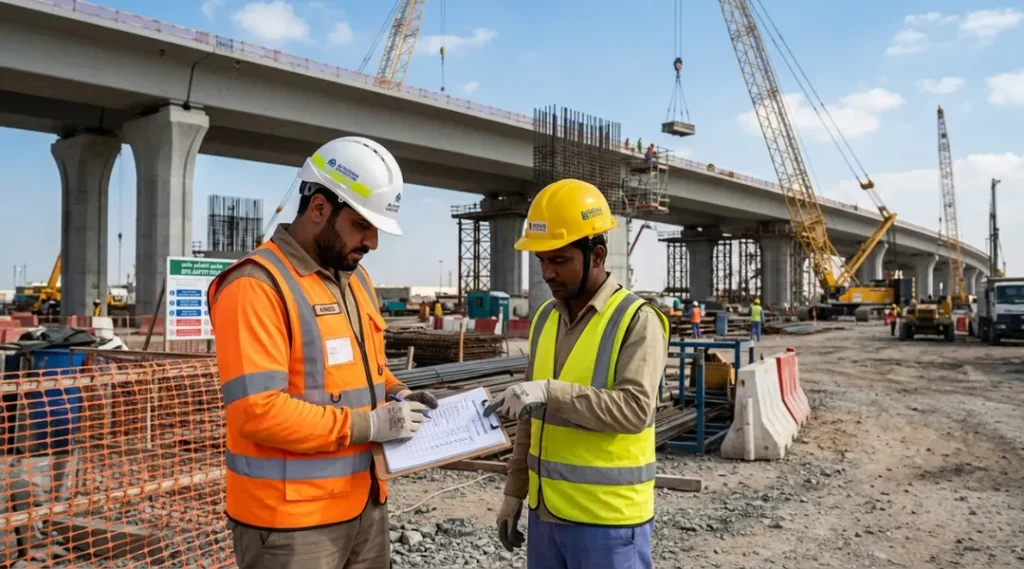
If you supervise workers, manage a job site, or carry any safety responsibility at your workplace, the OSHA 10-hour course was never designed for you. OSHA says it plainly: the 30-hour class is more appropriate for supervisors or workers with some safety responsibility.
That single sentence from OSHA’s own guidelines tells you exactly who this credential is built for. Yet thousands of supervisors, foremen, and safety officers across construction, oil and gas, manufacturing, and infrastructure still hold only an OSHA 10 card, leaving a visible gap on their CV and a real gap in their hazard management skills.
This guide covers everything about OSHA 30-hour training in 2026: who needs it, what the curriculum actually covers, how it compares to OSHA 10, what it does for your career, and how to complete it online through an authorized provider from anywhere in the world.
OSHA 30-hour training is a supervisor-level safety course delivered through OSHA’s Outreach Training Program. It works by training workers with safety responsibilities to recognize hazards, manage safety programs, and apply OSHA standards across a minimum of 30 contact hours. Unlike the 10-hour course designed for entry-level workers, OSHA 30 targets foremen, supervisors, site engineers, and safety coordinators. Completion earns a DOL course completion card recognized by employers across the construction, oil and gas, manufacturing, and infrastructure sectors. As of 2024, OSHA 30-hour cards represent approximately 30% of all Outreach Program completions, with demand growing steadily in both US and international markets (OSHA, 2024).
What Is OSHA 30-Hour Training?
OSHA 30-hour training is the advanced tier of OSHA’s Outreach Training Program, designed for supervisors and workers with safety management responsibilities. It covers hazard identification, safety program development, regulatory compliance, and incident prevention across 30 contact hours. Completion earns a DOL wallet card, not a license, but a widely recognized proof of supervisory-level safety education.
Start with the distinction that matters most. OSHA created two levels in the Outreach Training Program for a reason. The 10-hour course introduces entry-level workers to hazard awareness and their basic rights. The 30-hour course goes significantly deeper, addressing how safety programs are built, how inspections work, how incidents are investigated, and how a supervisor can systematically reduce risk for the people working under them.
Think of OSHA 10 as learning the traffic laws. OSHA 30 is learning how to manage road infrastructure so accidents happen less often in the first place. Same world, very different responsibility level.
The DOL card you receive after completing OSHA 30 looks similar to the OSHA 10 card but carries different weight in the job market. Employers, contractors, and project owners in construction, oil and gas, and manufacturing use the 30-hour credential as a screening requirement for supervisory hires. In several US states, OSHA 30 is mandated on certain public projects for anyone in a supervisory role.
What the card is and is not:
OSHA explicitly states the Outreach card is not a certification or license in the legal sense. It is a course completion record. What it proves is that the holder completed a structured, OSHA-approved curriculum covering supervisory safety topics. That proof has real value in hiring, compliance audits, and project prequalification, even without being a formal professional license.
Why OSHA 30 Matters in 2026
OSHA 30 matters more now because supervisor-level safety mandates have expanded, international employers in construction and infrastructure increasingly require it for site management roles, and the gap between OSHA 10 and OSHA 30 has become a visible differentiator in hiring decisions. Workers who hold only OSHA 10 are being passed over for supervisory positions where OSHA 30 is expected.

The enforcement data explains the pressure. OSHA’s FY 2024 top violations included Fall Protection, Hazard Communication, Lockout/Tagout, and Scaffolding, with penalties for serious violations reaching up to $16,550 per incident (OSHA Penalty Structure, 2024). Employers who want to reduce that exposure need supervisors who understand not just what the hazards are, but how to build systems that prevent them. OSHA 30 addresses exactly that.
State mandates have also expanded. New York’s Labor Law and public works regulations require OSHA 30 for supervisors on many state-funded construction projects. Nevada, Connecticut, and Rhode Island have parallel requirements. Major private-sector contractors, particularly in oil and gas and petrochemical construction, now write OSHA 30 into subcontractor prequalification checklists as a non-negotiable requirement for supervisory personnel.
The international picture is equally compelling. Workers from India, UAE, Saudi Arabia, and Malaysia who target supervisory and safety officer roles on international projects, offshore platforms, and EPC contracts are routinely asked for OSHA 30 alongside NEBOSH IGC or IOSH Managing Safely. Holding OSHA 30 signals a standardized level of supervisory safety competence that crosses national borders in a way that purely local credentials do not.
One pattern I have seen consistently across international safety job markets: the candidates shortlisted for supervisory roles on Gulf region infrastructure and energy projects almost always carry OSHA 30 as a baseline alongside NEBOSH. Without it, even strong candidates face an uphill prequalification battle.
The Bureau of Labor Statistics projects 12% job growth for occupational health and safety specialists from 2024 to 2034, significantly faster than the average for all occupations (BLS Occupational Outlook Handbook, 2024). OSHA 30 positions workers squarely in that growth track.
Who Should Take OSHA 30?
OSHA 30 is designed for supervisors, foremen, site engineers, safety coordinators, and any worker who directs others or carries formal safety responsibilities. If your job involves overseeing a crew, managing a work area, conducting safety inspections, or running a safety program, OSHA 30 is the appropriate credential. OSHA 10 is not.

OSHA’s own guidance makes the intended audience clear: the 30-hour class is designed for workers with supervisory responsibilities. That phrasing covers a wider group than many people initially expect.
Role | Industry | Why OSHA 30 Applies |
Site Supervisor / Foreman | Construction, Infrastructure | Directly responsible for crew safety; must recognize and correct hazards before incidents occur |
HSE Officer / Safety Coordinator | Oil and Gas, Manufacturing, Construction | Requires deep knowledge of OSHA standards to run a compliant safety program |
Project Engineer / Site Engineer | Construction, Civil, Petrochemical | Manages technical operations where regulatory compliance intersects with daily work activities |
Safety Manager | All industries | Leads incident investigations, safety audits, training programs, and regulatory responses |
Lead Technician / Senior Operator | Manufacturing, Utilities, Logistics | Supervises junior workers in environments with machine, chemical, or electrical hazards |
EPC / Contractor Safety Rep | Oil and Gas, Infrastructure | Required for prequalification on many large project contracts in US, UAE, and Saudi Arabia |
Fresh Graduate targeting HSE roles | Any | Differentiates from other candidates; shows readiness for supervisory responsibility from day one |
A common question I get: do I need to complete OSHA 10 before taking OSHA 30? OSHA does not require OSHA 10 as a prerequisite for OSHA 30. If you have supervisory experience and are ready for the more advanced curriculum, you can go straight to OSHA 30. That said, workers with no prior safety training often find the OSHA 10 content provides helpful foundational context before they tackle the broader OSHA 30 material.
OSHA 30 Course Curriculum: What You Actually Learn
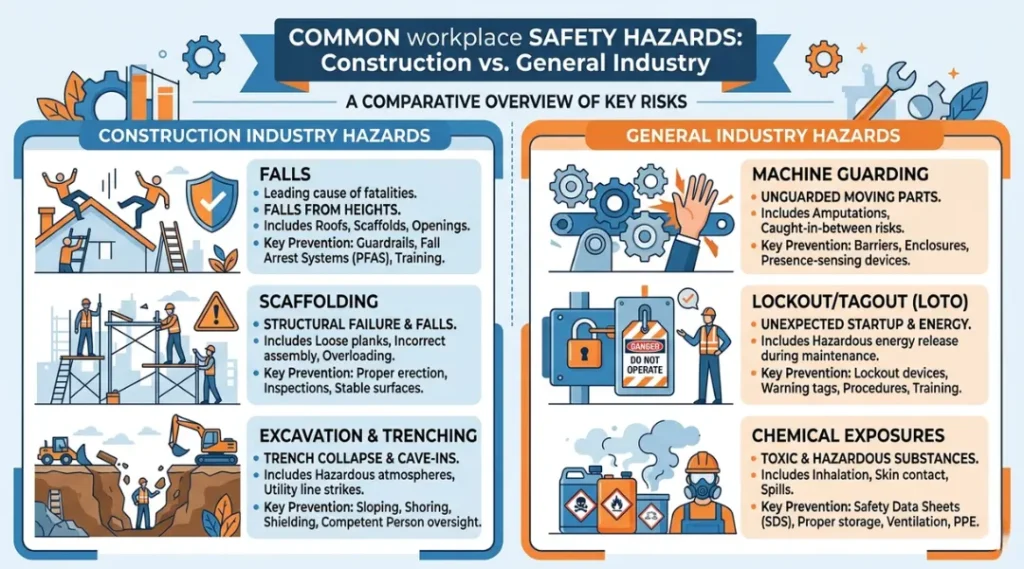
OSHA 30 curriculum covers mandatory core topics including Introduction to OSHA, Managing Safety and Health, and four primary hazard areas, plus elective modules selected by the provider. The construction track focuses on falls, electrical, struck-by, and caught-in hazards; the general industry track covers machine guarding, lockout/tagout, hazard communication, and industrial hygiene. Total contact time is 30 hours minimum.

Construction Track (29 CFR Part 1926)
The construction track is designed for the job site environment: trades, civil infrastructure, heavy equipment, and high-hazard operations. Mandatory topics include:
- Introduction to OSHA and the Outreach Program
- Managing Safety and Health: safety program design, roles, and accountability
- OSHA Focus Four Hazards: fall protection, struck-by incidents, caught-in/between, and electrical
- Health hazards in construction: silica, lead, noise, heat illness
- Excavation and trenching safety
- Scaffolding: erection, use, inspection, and fall protection requirements
- Personal Protective Equipment (PPE) selection and use
- Tools, hand tools, and power equipment safety
- Materials handling, storage, and disposal
General Industry Track (29 CFR Part 1910)
The general industry track addresses manufacturing plants, warehouses, utilities, healthcare settings, and other non-construction workplaces. Mandatory topics include:
- Introduction to OSHA and the Outreach Program
- Managing Safety and Health: hazard analysis and safety program management
- Lockout/Tagout (LOTO): energy control procedures for maintenance and servicing
- Machine guarding: fixed guards, point-of-operation guards, safeguarding principles
- Hazard Communication: SDS management, chemical labeling, employee training requirements
- Bloodborne pathogens: exposure controls for healthcare and first aid environments
- Personal Protective Equipment: selection, fit, maintenance, and documentation
- Walking-working surfaces: slips, trips, and fall prevention in industrial settings
- Fire safety: suppression systems, evacuation, hot work permits
- Electrical safety in general industry: arc flash, NFPA 70E basics, safe practices
Elective Topics
Providers select elective topics from OSHA’s approved list based on the learner audience. Common electives include confined space entry, ergonomics, forklift safety, hazardous materials handling, and process safety management. At M2Y Global Academy, elective topics are selected to reflect the real-world environments of our international learners, including oil and gas site operations, petrochemical plant environments, and large-scale construction projects.
OSHA 10 vs. OSHA 30: The Complete Decision Guide
Choose OSHA 10 if you are an entry-level worker with no supervisory responsibility and need foundational hazard awareness. Choose OSHA 30 if you supervise others, manage safety programs, or hold any formal safety role. The two courses are not interchangeable: OSHA 10 cannot substitute for OSHA 30 on job applications or project compliance documents that specify the 30-hour credential.
Factor | OSHA 10 | OSHA 30 |
Who it is designed for | Entry-level workers, new hires, site helpers | Supervisors, foremen, safety officers, engineers |
Total contact hours | 10 hours minimum | 30 hours minimum |
Curriculum depth | Hazard awareness and worker rights | Safety program management, audit skills, deep hazard analysis |
OSHA’s own description | For entry-level workers | For supervisors or workers with safety responsibility |
State mandates | NY, CT, NV, MO, RI for site workers | NY, CT, NV, MO, RI for supervisors on covered projects |
Typical online cost | USD $59-$79 / AED 220-290 / INR 4,900-6,600 | USD $159-$189 / AED 585-695 / INR 13,300-15,800 |
Completion time | 2 to 3 days (self-paced online) | 4 to 7 days (self-paced online) |
Card delivery | Within 90 days of completion | Within 90 days of completion |
Career positioning | Entry-level site access credential | Supervisory and safety management credential |
International recognition | Strong for site access in Gulf and SE Asia | Strong for supervisory and HSE officer roles globally |
Can substitute for the other? | No | No |
The most common question is whether completing OSHA 30 makes the OSHA 10 card redundant. Practically speaking, yes. OSHA 30 covers all core OSHA 10 content and more. If you hold OSHA 30, you do not need to separately present an OSHA 10 card. Most employers who require OSHA 10 will accept OSHA 30 as meeting that requirement and exceeding it.
Online vs. Classroom OSHA 30 Training
Online OSHA 30 training through an authorized provider produces a DOL card identical to one earned through in-person training. The key requirement is authorization: only providers on OSHA’s published list can issue valid cards. For international learners and working professionals, online delivery offers schedule flexibility that in-person training rarely provides.
Factor | Online OSHA 30 | Classroom OSHA 30 |
Card validity | Identical DOL card | Identical DOL card |
OSHA authorization required | Yes | Yes |
Schedule flexibility | Study at your own pace across sessions | Fixed class dates and times |
Geographic access | Available from any country with internet | Requires travel to training venue |
Cost (USD) | USD $159-$189 / AED 585-695 | USD $250-$500+ depending on location |
Instructor access | Asynchronous; varies by provider | Live, real-time instructor interaction |
Completion time | 4 to 7 days typically, spread across sessions | Typically 3 to 5 classroom days |
Best for | Working professionals, international learners | Learners who benefit from structured group settings |
Language options | English, sometimes multilingual at select providers | Typically English only in US venues |
OSHA formally authorized online Outreach training delivery in 2020, removing the stigma that had previously attached to online OSHA cards. Employers and compliance officers now accept online-issued OSHA 30 cards without distinction from in-person cards, provided the issuing provider is authorized. That final condition is the one that matters: always verify authorization before enrolling.
One practical note for international learners: online delivery is the only realistic option for workers based in India, UAE, Saudi Arabia, Malaysia, or the UK who want a US OSHA-aligned credential. M2Y Global Academy’s online OSHA 30 program is structured specifically for this audience, with support across time zones and multilingual instructor access.
Career Advancement with OSHA 30: Roles, Salaries, and Demand
OSHA 30 delivers measurable career benefits: it qualifies workers for supervisory and safety officer roles, increases earning potential across construction, oil and gas, and manufacturing, and is a recognized credential in employer prequalification for major projects in the US, UAE, Saudi Arabia, and beyond. Workers with OSHA 30 consistently earn more than those with OSHA 10 alone.
Roles that typically require or prefer OSHA 30
- Construction Site Supervisor / Foreman
- HSE Officer / Safety Officer
- Safety Coordinator
- Site Safety Manager
- Project Engineer with safety oversight
- EPC Safety Representative
- Maintenance Supervisor in manufacturing
- Oil and Gas Site Safety Lead
Salary data by country (2024-2026 estimates)
Country | Role | Typical Annual Salary (OSHA 30 Holder) | Source / Basis |
United States | Safety Officer / Supervisor | USD $65,000-$95,000 | BLS OOH 2024, industry surveys |
UAE / Gulf Region | HSE Officer (Oil and Gas) | AED 84,000-168,000 (USD $23,000-$46,000) | Gulf safety job market data 2024 |
Saudi Arabia | Safety Supervisor (EPC projects) | SAR 72,000-144,000 (USD $19,000-$38,000) | Aramco contractor market surveys |
India | HSE Engineer / Safety Officer | INR 420,000-960,000 (USD $5,000-$11,500) | Naukri / LinkedIn salary data 2024 |
Canada | Construction Safety Officer | CAD $65,000-$90,000 (USD $48,000-$67,000) | Canadian safety industry benchmarks |
United Kingdom | Site Safety Manager | GBP 35,000-52,000 (USD $44,000-$65,000) | UK safety sector salary surveys 2024 |
Malaysia | Safety Officer (Construction) | MYR 36,000-72,000 (USD $7,500-$15,000) | DOSH-aligned market data 2024 |
The salary premium for OSHA 30 over OSHA 10 is most pronounced in supervisory roles where the credential is a stated requirement, not merely preferred. Workers who hold OSHA 30 alongside NEBOSH IGC or IOSH Managing Safely command the highest rates internationally, particularly in Gulf region energy and infrastructure.
When OSHA 30 Alone May Not Be Enough
OSHA 30 is a strong foundation but is not the final word in every market. In the UK, NEBOSH IGC remains the dominant credential for safety professionals. In Malaysia, DOSH-recognized qualifications carry regulatory weight that OSHA 30 alone does not. For workers targeting these specific markets, combining OSHA 30 with the locally relevant credential produces the strongest application package. M2Y Global Academy offers both OSHA and NEBOSH programs, making it possible to build a combined credential portfolio in a structured sequence.
International Recognition and Validity
OSHA 30 is recognized by employers across the construction, oil and gas, manufacturing, and infrastructure sectors in over 30 countries. It is not a universal regulatory credential outside the United States, but it is widely accepted as a signal of supervisory safety competence. Gulf region EPC contractors, Southeast Asian infrastructure projects, and Canadian construction companies routinely list OSHA 30 in job requirements for safety roles.
Country / Region | OSHA 30 Recognition Level | Commonly Required For | Recommended Complement |
United States | Full regulatory recognition | Supervisory roles on mandated state projects; employer prequalification | CSP, CHST for advanced roles |
UAE / GCC Region | Strong employer recognition | HSE officer roles on EPC and infrastructure contracts | NEBOSH IGC, OSHAD certifications |
Saudi Arabia | Strong on Aramco and large EPC projects | Safety supervisor and site HSE roles | NEBOSH IGC, client-specific safety orientation |
India | Growing employer recognition | HSE roles with multinational contractors and export-oriented industries | IOSH Managing Safely, NEBOSH IGC |
Malaysia | Recognized by multinational employers | Safety roles with international contractors | DOSH-registered qualifications |
Canada | Recognized alongside NCSO | Construction supervisors on projects with US affiliates or investors | NCSO, Red Seal trades qualification |
United Kingdom | Limited regulatory weight; employer-recognized | International project experience; roles with US-linked contractors | NEBOSH NGC, IOSH Managing Safely |
The practical test for international recognition is simple: look at the job description for the specific role you are targeting. If the employer is a multinational contractor, an oil and gas company with US affiliations, or a Gulf region EPC firm, OSHA 30 will almost always appear as preferred or required. If the employer is a purely local company operating under a domestic regulatory framework, OSHA 30 may not carry direct regulatory value, but still signals a level of safety literacy that many employers value regardless.
How to Enroll and What to Expect
Enrolling in OSHA 30 requires choosing your industry track, selecting an OSHA-authorized provider, completing all 30 contact hours across mandatory and elective modules, passing provider assessments, and receiving your DOL completion card within 90 days. Online delivery allows completion across multiple sessions at your pace. The full process typically takes between 4 and 7 days of study time spread across 2 to 4 weeks.
Step 1: Choose your industry track
Decide between Construction (29 CFR Part 1926) and General Industry (29 CFR Part 1910). Match the track to your primary work environment. If your job involves site work, civil construction, trades, or heavy equipment, choose Construction. If your work is in manufacturing, logistics, warehousing, utilities, or healthcare, choose General Industry. Choosing the wrong track will produce a card that does not satisfy your specific employer or project requirement.
Step 2: Verify your provider is OSHA-authorized
OSHA publishes a list of authorized online providers. Only providers on that list can issue valid DOL cards. Before enrolling anywhere, verify the provider’s authorization status. Non-authorized certificates are rejected by employers and state compliance officers regardless of how professional the provider’s materials appear.
M2Y Global Academy delivers OSHA-aligned training recognized by employers in 30+ countries. Speak with our advisors to confirm the right course track and format for your specific target employer or country.
Step 3: Complete all 30 required contact hours
OSHA requires a minimum of 30 contact hours. Online providers structure the course across modules with mandatory and elective content. You can pause and resume between sessions, but the full 30 hours must be completed. Most learners spread study across 2 to 4 weeks, dedicating 1 to 3 hours per session.
Step 4: Pass module assessments
Most authorized providers include module quizzes and a course completion assessment. OSHA requires providers to verify comprehension. The content is designed for supervisory learners, not engineers or safety specialists. If you engage with the material as you go rather than rushing through it, passing is straightforward.
Step 5: Receive and protect your DOL card
OSHA requires trainers to issue completion cards within 90 days. Most online providers process cards in 2 to 6 weeks. Photograph your card immediately on arrival. OSHA does not maintain a centralized card registry, and replacement depends on the original trainer within a five-year lookback window. A digital backup takes 30 seconds and prevents significant administrative problems down the line.
Frequently Asked Questions About OSHA 30-Hour Training
OSHA 30 is mandatory for supervisors on certain public construction projects in New York, Connecticut, Nevada, Missouri, and Rhode Island. Many large private contractors also require it for subcontractor supervisors as a prequalification condition. Outside the US, it is not a regulatory requirement but is widely expected by international employers in construction, oil and gas, and infrastructure for supervisory roles.
OSHA 30 requires a minimum of 30 contact hours. Online learners typically spread completion across 4 to 7 days of study time over 2 to 4 weeks. The DOL completion card is issued within 90 days of finishing the course, though most authorized online providers process cards within 2 to 6 weeks.
OSHA 30 training through M2Y Global Academy / M2Y Safety Consultancy is affordably priced and accessible globally. Typical market cost ranges from USD $159-$189 / AED 585-695 / INR 13,300-15,800 depending on provider and track. Avoid providers charging significantly below this range without verified OSHA authorization.
Yes. OSHA formally authorized online Outreach training delivery in 2020. Cards issued by authorized online providers are identical to those from in-person courses. Employers and compliance officers cannot distinguish between online and in-person cards from authorized providers. The key is provider authorization: always verify before enrolling.
OSHA 30 cards do not carry an official expiration date. However, many employers and state agencies set informal renewal expectations of 3 to 5 years. New York recognizes cards within a 5-year lookback for replacement purposes. Workers in active safety roles are advised to refresh every 3 to 5 years to stay current with updated OSHA standards and enforcement priorities.
Practically yes. OSHA 30 covers all core OSHA 10 content and goes significantly further. Most employers who require OSHA 10 will accept OSHA 30 as meeting and exceeding that requirement. You do not need to hold both cards if you have completed OSHA 30.
Yes. OSHA 30 is recognized by multinational employers and EPC contractors across UAE, Saudi Arabia, India, Malaysia, Canada, and the UK. It is particularly valued for supervisory and HSE officer roles on large construction, oil and gas, and infrastructure projects. It does not replace local regulatory credentials but is widely accepted alongside them as a signal of supervisory safety competence.
OSHA 30 Construction follows 29 CFR Part 1926 and focuses on falls, scaffolding, excavation, cranes, and other jobsite hazards. OSHA 30 General Industry follows 29 CFR Part 1910 and covers machine guarding, lockout/tagout, hazard communication, and industrial environments. Choose based on your primary workplace. The two tracks are not interchangeable for employer or compliance purposes.
What to Learn Next
OSHA 30 is a strong supervisory credential. Here are the natural next steps in your safety career journey:
- OSHA 10 vs. OSHA 30: Which One Should You Choose? A complete side-by-side comparison if you are still deciding between the two.
- OSHA 10-Hour Training: Complete Guide. If you or your team members need the entry-level credential first.
- Safety Officer Certification: Career and Course Guide. The next credential milestone after OSHA 30 for workers targeting HSE officer roles.
- OSHA Certification: The Complete Guide for 2026. How OSHA 30 fits into the broader OSHA certification landscape including specialty credentials.
- OSHA Training in UAE, India, and Saudi Arabia. Country-specific guides for international learners covering employer recognition, local market demand, and enrollment options.
Conclusion
Three things to take away from this guide:
- OSHA 30 is the supervisor-level credential. If you direct others, manage safety programs, or carry any formal safety responsibility at your workplace, OSHA 30 is the right credential. OSHA 10 was not designed for your role, and presenting it as your primary safety credential leaves a visible gap on every job application.
- Online delivery is legitimate and equally valid. Cards from authorized online providers are identical to in-person cards. What matters is provider authorization, not delivery format. Always verify before you enroll.
- OSHA 30 opens supervisory doors internationally. Whether you are targeting a site supervisor role in the UAE, a safety officer position in Saudi Arabia, an HSE engineer job in India, or a construction foreman role in Canada, OSHA 30 is the credential that appears consistently in multinational employer requirements.
M2Y Global Academy delivers OSHA 30-hour training specifically designed for international learners, with affordably priced flexible online access, multilingual support, career guidance, and credentials recognized by employers across India, UAE, Saudi Arabia, Malaysia, Canada, US, the UK, and worldwide.